
This is a special entry for Swinging Through Comics, and it goes a little off the beaten path. Rather than a standard review, this piece is devoted to the memory and work of Shotaro Ishinomori, and specifically his manga adaptation of The Legend of Zelda A Link to the Past.
You may not immediately recognize the name Shotaro Ishinomori, but if you have ever watched Power Rangers, then you already know his work. He was the original creator of Go Ranger, which launched Super Sentai and eventually became Power Rangers in the West. Before that there was Kamen Rider. Before that there was Skull Man. Before that there was Cyborg 009 and Kikaider.
Ishinomori was a student and collaborator of Osamu Tezuka, and he holds the Guinness World Record for producing more manga pages than any other individual in history. His career spanned over forty years, and his influence across manga and live action storytelling is enormous.
Toward the later part of his career, in 1992, Nintendo contacted Ishinomori and commissioned him to adapt The Legend of Zelda A Link to the Past into a serialized comic. The manga ran in Nintendo Power magazine and was aimed at an American audience. Years later, in 2015, VIZ released the full watercolor collected edition.
When I first saw this book at my local comic shop, it was not a question of whether or not I should buy it. I already had a fondness for Zelda, and I was already a fan of Ishinomori’s work through Kamen Rider and his manga catalog. It felt like something that was made for me.
First Impressions and Overall Reaction
It is difficult for me to talk about this book in a completely objective way because I have a strong affinity for Ishinomori’s work. That does not mean I am unwilling to criticize it, but it does mean I come to it with a lot of goodwill.
Overall, I really enjoyed this manga. The story was deeper and more emotional than I expected. The artwork is beautiful, especially in the watercolor collected edition. If you have the physical book in hand, it is a real treat. You can see the different media at work, and the textures and tones add a lot to the atmosphere.
I have reread this manga many times over the years. I have read it to myself, and I have read it to my kids. Even with its flaws, I keep coming back to it.
Pacing and Structure
My main criticism of the book is the pacing. Many chapters feel structured in a staggered way. Something concludes from the previous chapter, and then the story immediately pivots to set up the next one. This happens repeatedly, and it can feel artificial, like the structure is designed to keep you moving rather than letting moments breathe.
That said, I suspect this pacing was intentional. The comic was serialized, and it was meant to keep readers excited for the game without spoiling everything. In that sense, it succeeds. If you played the game, the comic feels like a companion piece. If you read the comic first, it does not give everything away.
The plot closely mirrors the game, but it adds just enough extra material and character focus to feel worthwhile.
Art Style and Visual Storytelling
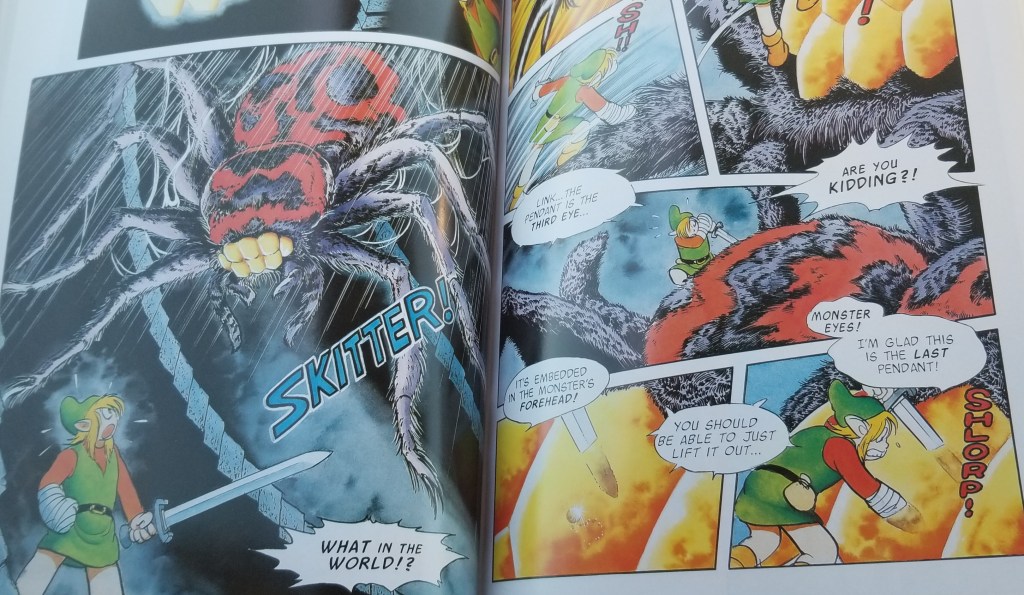
Ishinomori’s version of Link is very simple and cartoony, especially compared to the richly illustrated environments around him. Normally, I am not a huge fan of that contrast, but it works here because Ishinomori’s characters are never static. They move. They react. They emote.
The creature designs are fantastic. There are giant spiders, eerie eye monsters, three headed dragons, and twisted beasts from the Dark World. Many of these fights are brutally quick, sometimes so quick that I wanted them to last longer, but they are memorable.
One of the most impressive aspects of the art is Ishinomori’s use of establishing shots. Ruins, castles, and distant locations are often shown in silhouette, heavy with shadow, making Link feel small and daunted by what lies ahead. These moments give the story a mythic weight.
The Master Sword is treated with real reverence. The sequence of Link reaching for it, grasping it, and being charged with power is dramatic and visually striking.
Darkness, Transformation, and Moral Weight
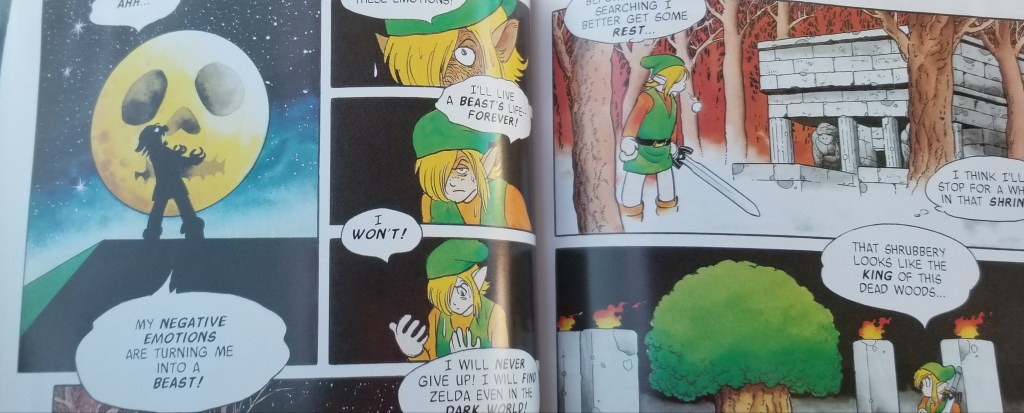
One of my favorite aspects of the story involves the Dark World and the idea that it reflects what is in a person’s heart. Corruption does not just make people evil. It locks them into beast forms that reveal their inner nature.
There is a powerful moment where Link is injured and partially transformed because of the darkness he is carrying with him. His grief over the death of his uncle and his desire for vengeance actively hurt him. The visual storytelling in these scenes is excellent, using harsh light, color contrast, and silhouette to communicate pain and inner conflict.
This gives the story a surprising moral and spiritual dimension. It is not just an adventure. It is about restraint, grief, and the danger of holding onto hatred.
Rome as a Foil to Link
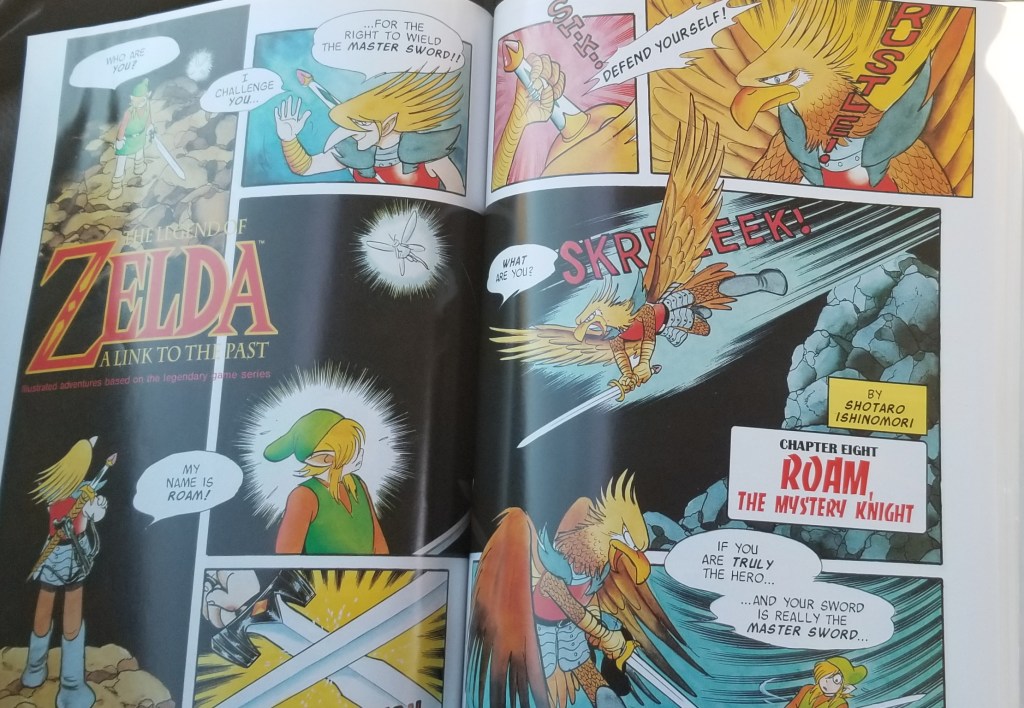
One of the most interesting additions unique to the manga is the character Rome. He is a descendant of the Knights of Hyrule and believes he is destined to be the legendary hero. He wants the Master Sword. He wants to defeat Ganon for the honor of his lineage.
Rome serves as a foil to Link. Link begins the story without knowledge of the legend. His motivation is personal grief and a desire to protect Zelda. Rome knows the legend but lacks a personal connection to the conflict.
Their paths intersect, clash, and ultimately influence each other. Rome’s eventual transformation into a bird like warrior is visually striking and very much in line with Ishinomori’s design sensibilities. The contrast between the two characters sharpens Link’s emotional arc and highlights the difference between ambition and humility.
Zelda, Pathos, and the Ending
The ending of the manga includes a quiet, melancholic note that I really appreciated. Zelda has become queen. Link has become the head of the Knights of Hyrule. The telepathic bond they once shared is gone, and with it a deeper connection that can never fully return.
There is a sense of unspoken loss and unrequited closeness. Duty prevents them from being together in the way they once were. It is far more emotionally complex than it needed to be, and that is one of the reasons this adaptation stands out.
Final Thoughts
Shotaro Ishinomori’s A Link to the Past manga is not perfect. The pacing can feel rushed. Some action scenes end too quickly. Not every charming element can be credited solely to Ishinomori rather than the Zelda source material.
But the book is elevated by strong visual storytelling, mythic atmosphere, emotional weight, and thoughtful character contrasts. It turns what could have been a simple tie in adaptation into something memorable and meaningful.
I have returned to this manga again and again over the years, and I expect I will continue to do so. It surprised me when I first read it, and it still surprises me now.
What do you think of Ishinomori’s A Link to the Past? Have you read it yet?
Drop a comment below or tag me @MJ_Scribe on Twitter. Let’s have some fun talking about this.
If you enjoy thoughtful stories for kids and families, check out my book Mockwing Mayhem. It is a heartfelt adventure about magical bugs battling monsters and protecting children.
You can find more of my reviews, reflections, and stories with spine at mjmunoz.com, and join the mailing list there for behind the scenes updates and new releases.
BONUS Section
A full-color graphic novel by manga legend Shotaro Ishinomori based on the classic video game The Legend of Zelda: A Link to the Past.

The Legend of Zelda: A Link to the Past is an adaptation of the beloved, internationally bestselling video game originally released for Nintendo’s Super Entertainment System. This comic book version by Shotaro Ishinomori (Cyborg 009, Kamen Rider) was first serialized in Nintendo Power magazine and later collected into a graphic novel. Long out of print, this stunning, full-color graphic novel is now available once again!
From an earlier release: The Legend of Zelda: A Link to the Past is a comic book miniseries by Japanese manga artist Shotaro Ishinomori based on the game of the same name. It appeared in Nintendo Power beginning in January 1992 and ran for 12 issues, ending in December 1992. It was later published as a graphic novel in 1993.
 MJ Muñoz