RSS Feed | Podcast Index | Spotify | Amazon Music | Samsung Podcasts | Listen Notes
Apple Podcasts | Google Podcasts | Pandora | Tune In | Stitcher | iHeartRadio | Deezer

8 Point Arc, Infinite Potential? – Learning In Public |Story Over Everything 024 – Fortress Fiction
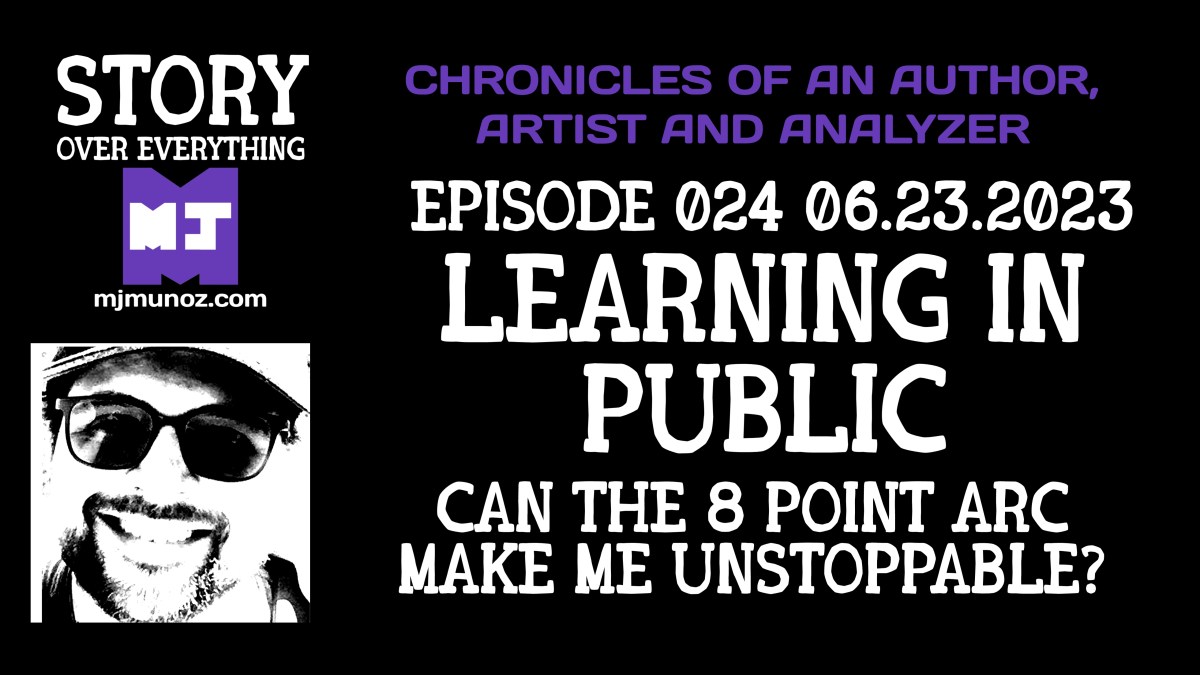
Join MJ as he switches gears from writing in public to LEARNING in public. Find out the latest resources he is taken by and where you can learn more about them. He is thinking the 8 point arc is a perect asset for him.
#amwriting #writer #author #WritingCommunity
TOPICS
Joanna
MENTIONED
N/A
DICTATION TRANSCRIPT 3
Grobug Tales Chapter 8
RAW RESULTS
(I will clean up this transcript and put it into the manuscript. This might be most of chapter 8)
_
LINKS
ML Ronn’s Be a Writing Machine
Lee Mc George’s Novel Writing Playlist and The Obsidian
The 8-point story arc . . . or How To Construct Engaging Scenes
Jeffrey H Haskell’s FULL METAL SUPERHERO – A COMPLETE 9 BOOK SERIES
Check out the Blog Version of the Transcript below:
Title: Becoming a Writing Machine: My Journey as an Author – Part 1
Hey there, it’s MJ! As an author, artist, and analyzer, I’m always on the lookout for ways to improve my writing craft. In this episode of Story Over Everything, I delve into my ongoing journey as a writer and share some insights I’ve gained along the way. So grab a cup of coffee, sit back, and let’s dive into the fascinating world of writing.
New Resources
Recently, I stumbled upon an intriguing audiobook that caught my attention. It was a book on the writing process and craft, and without much hesitation, I decided to give it a go. Titled “Be a Writing Machine” by M.L. Ron, the book seemed like the perfect fit for my aspirations. Coupled with the author blueprint from Joanna Penn that I explored last week, these resources have truly inspired me to keep pushing myself as a writer.
The Importance of Daily Writing
I’ve set a personal goal for myself to write at least 10 minutes every day. It’s a modest target, but one that I believe forms the foundation of discipline and consistency. The idea is to develop a habit of daily writing, which will eventually lead to increased productivity and creative output. Of course, if I exceed the 10-minute mark, that’s even better!
Balancing Time and Commitments
Sometimes life gets in the way, throwing unexpected challenges and interruptions our way. A recent incident involving a new gadget kept me awake in the middle of the night, hampering my sleep and leaving me fatigued the next day. Despite the exhaustion, I’ve managed to maintain a dedicated writing routine, combining it with other activities like drawing and exercising to ensure a holistic approach to my creative pursuits.
Striving for Writing Efficiency
As I reflect on my writing journey, I’m faced with questions about efficiency and productivity. Can I maintain a steady pace by writing a fixed number of words each day? Or should I focus on allocating a specific amount of quality time for writing? These questions led me to contemplate the concept of “junk in, junk out” and the importance of producing meaningful content rather than just reaching a word count.
Exploring Writing Methods
M.L. Ron’s book suggests an alternative approach to drafting and outlining. He advocates for writing a single draft without the need for extensive outlining. While this method doesn’t entirely align with my preferred snowflake method, it has sparked my curiosity to explore different techniques and find a personalized method that suits my creative process. I intend to develop a clear strategy and document it, allowing me to refine and expand upon it over time.
The Path to Becoming a Writing Machine
My ultimate goal is to transform myself into a writing machine, someone capable of consistent output and quality writing. To achieve this, I plan to track my progress over the next 30 days of daily writing. At the end of this period, I’ll assess whether I should increase the writing time or set a specific word count goal. While a higher word count may seem tempting, I understand the importance of maintaining writing quality and avoiding unnecessary padding.
Exploring Pulp Novels and Writing Cadence
I’ve always been fascinated by pulp novels and their fast-paced nature. I contemplate the ideal cadence for releasing books—whether it’s writing six books a year or adhering to a more relaxed schedule. To gain insights, I’ve examined the work of authors like Jeffrey A. Haskell, who produced several books within a short timeframe. While I’ve noticed minor flaws in some of these books, they didn’t detract from my overall enjoyment as a reader.
Discovering an Inspiring Author
As I delve deeper into my passion for writing, I come across an author who captivates me with his personality and approach. What truly impresses me is that he has already written an astonishing 40 books, an achievement that amazes and motivates me. Although I can’t recall when he started writing seriously, his prolific output of eight books per year is both inspiring and awe-inspiring.
The Call to Action
During one of his video presentations, the author encourages viewers to take action. He shares links to courses and books, including his own works, that he believes would be beneficial to those interested in the subject matter. The title of one of his books catches my attention, and I feel compelled to explore it further. Additionally, he recommends a book on writing pulp stories, which piques my curiosity and leads me to consider adding it to my reading list.
Taking Responsibility for My Progress
One aspect of the author’s teachings that resonates with me is the importance of personal responsibility. I have come to realize that the progress I have made, or lack thereof, in publishing my own books is entirely my responsibility. Blaming external factors or circumstances is counterproductive. It’s time for me to take control and commit myself to the necessary work and discipline required to achieve my writing goals.
Honing My Craft
To further enhance my writing skills, I decide to take a short break from my creative writing projects. During this time, I plan to focus on honing my craft and developing a systematic approach that aligns with my goals. I envision creating a method or formula specifically tailored to my writing style. By refining my process and creating clear guidelines, I hope to streamline my work and make it more efficient and effective.
Seeking Guidance from Various Sources
In my quest for knowledge and inspiration, I explore different resources. One of them is Lee McGeorge, an indie horror author, who offers a comprehensive novel-writing course on YouTube. I find his documentation of the writing process fascinating, as he shares his journey from developing an idea to fleshing out a complete novella. The course introduces the eight-point story structure, which complements the three-act structure I’m already familiar with. I plan to incorporate aspects of both methods into my own writing approach, combining and adapting them to suit my needs.
Creating Protocols and Principles
I strongly believe in having protocols and principles to guide my storytelling. These frameworks provide a solid foundation and help generate cohesive and compelling narratives. By assembling ideas and brainstorming, I can bring together diverse elements and then utilize the eight-point structure to flesh out characters, settings, and plotlines. This top-down approach, starting with a one-sentence story summary, allows me to maintain organization and clarity throughout the development and writing process.
Discovering the Eight-Point Story Arc
As I mentioned in my previously, I’ve been on a quest to improve my writing skills and develop a stronger understanding of narrative structure. During my exploration, I stumbled upon various resources that delved into the eight-point story arc. This concept, I came to realize, offers a concise and effective way to construct a story, encompassing all the essential elements.
Flexibility and Applicability
What fascinated me most about the eight-point story arc is its versatility. It can be applied to various storytelling formats, from a single sentence summary to an entire chapter or scene. The arc consists of elements such as stasis, trigger, climax, reversal, and resolution, which can be thoughtfully woven together to create engaging narratives.
Constructing a Single Sentence
One of the intriguing aspects of the eight-point story arc is its potential to shape a single sentence summary of a story. It amazed me to realize that by incorporating the eight-point arc’s elements, one can create a sentence that encapsulates the essence of a narrative. This realization opened up a world of possibilities for me as I considered expanding my own stories using this concise yet comprehensive structure.
The Scalability of the Eight-Point Arc
Another aspect that captivated me about the eight-point story arc is its scalability. Not only can it be applied to individual scenes or chapters, but it can also provide a framework for the overarching structure of an entire novel. As I immersed myself in the teachings of Lee McGeorge, a prominent instructor on novel writing, I noticed how he referred to utilizing mini-arcs within his work, indicating the flexible nature of the eight-point arc.
The Power of Chapter Endings
I began to explore the significance of chapter endings and their impact on reader engagement. I learned that a chapter should not necessarily conclude when the events within it come to an end, but rather when a new development is about to unfold. By incorporating an “invisible question” or a moment of suspense at the end of a chapter, writers can create a sense of curiosity and entice readers to continue turning the pages.
Reflecting on Influential Authors
Throughout my writing journey, I’ve drawn inspiration from notable authors like Michael Crichton, J.R.R. Tolkien, and others. Observing their diverse chapter lengths and storytelling techniques, I realized that there is no strict rule regarding the number of scenes a chapter should contain. The key lies in maintaining a captivating pace and using chapter breaks strategically to maintain reader interest.
The Journey Continues
As I delve deeper into my exploration of the eight-point story arc and other writing techniques, I am both thrilled and humbled by the continuous learning process. I acknowledge that I have much to discover and refine in my craft, and I’m excited to share my progress and insights with you along the way.
Conclusion
Thank you for joining me on this leg of my writing journey. I hope you found this exploration of the eight-point story arc as fascinating as I did. Remember to visit MJMunoz.com, where you can find more of my analysis, art, and fiction covering a wide range of topics. Stay tuned for upcoming blog posts and the next chapter in my chronicles as a writer. Until then, take care and keep writing!
 MJ Muñoz