The Book of Three Chapter 10 On Lore and Lineage – Fortress Fiction
What did you think of The Book of Three Chapter 10 by Lloyd Alexander?
#amreading #middlegrade #bookreview #fantasy #Book #ChapterXChapter #PrydainChronicles #FOTRESSFICTION
VIDEO
How To Read
The book can be borrowed FREE from CloudLibrary and in audiobook format, or your local library or purchased from the publisher’s site and many online retailers including in audiobook format as well from KOBO, audible.
WIKI – The Chronicles of Prydain
Chapter 10 of The Book of Three:
The Fellowship of the Pig and Why Prydain Just Works
I don’t know if I’ve ever publicly said this before, so I’m just going to say it clearly now:
The Chronicles of Prydain is better than The Lord of the Rings.
I love Lord of the Rings. I love The Hobbit. In fact, I think The Hobbit is better than Lord of the Rings as well. And I would put The Chronicles of Prydain above The Hobbit too.
You can argue with me if you want. But if you’ve taken this journey with me—or honestly, if you’ve even just read The Book of Three—you probably already know it’s true. Search your feelings.
Now, I’ll admit this comparison isn’t entirely fair. The Book of Three came decades later, and Lloyd Alexander had the benefit of growing up with Tolkien already on the shelf. Of course he learned from that. Of course he absorbed it. But what matters is what he did with it.
People sometimes say Prydain is derivative. That it’s “kind of like” Lord of the Rings. And sure—if you squint. But it’s doing something so different, and so fresh, that you stop caring about the comparison almost immediately. It’s familiar in the way myths are familiar, not in the way copies are.
And Chapter 10, “Dyrnwyn,” is where that really clicks.
The Fellowship of the Pig (Yes, Really)
Chapter 10 is where we effectively get the formation of the fellowship. I keep calling it either the Fellowship of the Pig or the Fellowship of the Assistant Pig-Keeper, and honestly, both names work.
This is the moment where the cast locks in.
If you’re just dropping in and haven’t been reading along, here’s what we’ve got:
- Taran, our “simple” protagonist
- Eilonwy, who is… hard to categorize, in the best way
- Fflewddur Fflam, a noble who’s kind of a failed noble
- Gurgi, a strange, hungry creature who is neither man nor beast
- And yes, a horse (Melyngar, who is, despite protests, still a horse)
What’s fascinating is how naturally this group comes together.
Fflewddur chooses to stay.
Gurgi tags along to save his own skin, but also because he’s loyal.
Eilonwy fights to be included.
Taran carries guilt instead of glory.
None of this feels forced. None of it feels like a checklist. It feels like people making decisions for reasons that make emotional sense.
And that matters.
Taran and the Death of the Adventure Fantasy
One of the most important things happening here is Taran’s internal shift.
Earlier in the book, he wanted adventure. He wanted glory. He wanted to be important.
Now? He’s carrying guilt.
He feels responsible for what happened at Spiral Castle. He feels responsible for Gwydion’s capture. The adventure he wanted has arrived—and it’s not what he imagined.
This isn’t cynicism. It’s not world-weariness. It’s the quiet realization that wanting something doesn’t mean you understand the cost of it.
And what I love is how effortless this feels. Alexander doesn’t drown the reader in despair. He doesn’t bog the story down. The truth of the situation is allowed to exist without becoming oppressive.
That balance—between honesty and hope—is something Prydain does exceptionally well.
A Smaller Cast, Deeper Investment
One of the reasons this chapter works so well is the scale.
This is a small fellowship. And because it’s small, I care deeply about each member.
Compare that to the Nine Walkers, or Bilbo’s thirteen dwarves with their hard-to-remember names and thin characterization. Those groups have their strengths, but they never pulled me in the same way.
Here, every character feels like they’re on their own journey:
- Is Fflewddur going to become an honest man? Return to his kingdom? Become something greater?
- Is Gurgi cursed? Is there more to him than hunger and loyalty?
- Eilonwy has roots tied to darkness—does rejecting evil automatically make her good, or is that journey still ahead of her?
- And Taran? He’s still a mystery.
I’m invested in all of them. And that’s not an accident.
Structure Without Bloat
This chapter also highlights something I really appreciate about The Chronicles of Prydain as a whole: the structure.
These books feel like individual adventures that build on one another. They’re not bloated. They’re not padded. They move.
It reminds me of older pulp structures—the kind where characters are thrown into escalating situations, where there’s often a mid-story victory and then a final stretch where everyone gets to shine together. I sometimes call that final stretch the victory march.
Chapter 10 feels like the end of the opening movement. The world has been introduced. The dangers are clear. The fellowship is formed. The trajectory is set.
And it all happens with fewer words, fewer characters, and more emotional payoff.
That’s not a knock against Tolkien. It’s just an acknowledgment that Alexander’s presentation is more approachable without being shallow. The story is still nutritious. It’s just easier to digest.
Why This Chapter Matters
Chapter 10 is a lynchpin.
It changes the status quo. It establishes the new normal. It quietly sets the direction not just for the rest of The Book of Three, but for the entire series.
That’s why I allowed myself to zoom out so much here. This chapter invites that perspective. It earns it.
This isn’t an exhaustive breakdown. It’s a reflection. And I want to keep these reviews enjoyable, not turn them into a slog or an obligation. There’s more to say about this chapter—plenty more—but I’ll save some of that for shorter posts and videos.
For now, this feels like the right place to pause.
Drop a comment below or tag me @MJ_Scribe on Twitter. Let’s have some fun talking about this.
If you enjoy thoughtful stories for kids and families, check out my book Mockwing Mayhem. It is a heartfelt adventure about magical bugs battling monsters and protecting children.
You can find more of my reviews, reflections, and stories with spine at mjmunoz.com, and join the mailing list there for behind the scenes updates and new releases.
Bonus Section: Lore and Lineage in Chapter 10 (Extra)
This section is a bonus reflection based on a shorter companion video. You don’t need it to understand the review above, but if you like digging deeper, it’s here for you.
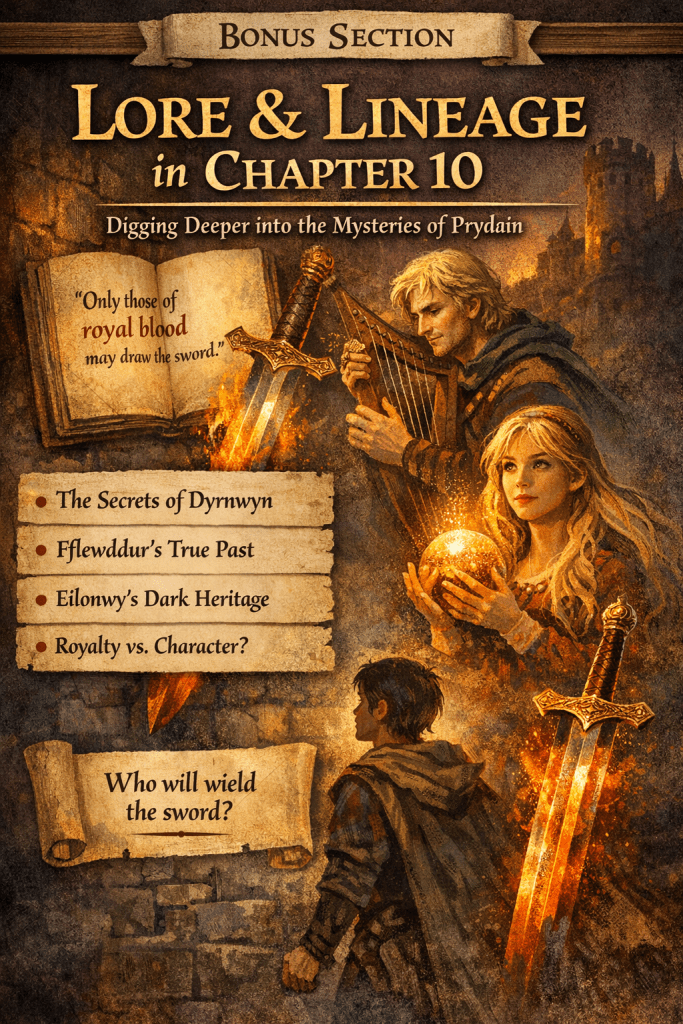
One of the reasons Chapter 10 stuck with me is just how densely packed it is with lore, lineage, and quiet setup.
I listened to this chapter three times. And each time, something new stood out.
We get:
- The lore of Dyrnwyn
- Insight into bards and their role in this world
- Fflewddur’s past as a king and the truth-binding nature of his harp
- Eilonwy’s family background and her fear of being sent back into darkness
And then there’s the inscription on Dyrnwyn. “Only those of royal blood may draw the sword.”
Royal. Not noble.
That distinction matters.
It raises questions. About lineage. About worth. About destiny. Does this mean Taran will wield the sword someday? Does blood matter—or does character?
Alexander doesn’t answer these questions here. He just plants them.
And that’s the genius of it.
Nothing feels like a lecture. Nothing feels like exposition. The information is woven into the story so naturally that you don’t realize how much groundwork is being laid until you stop and think about it.
That’s trust. Trust in the reader. Trust in the story. And trust that the seeds being planted now will matter later.
 MJ Muñoz