Visit Grobugs.com for updates on my new book featuring magical bug battling monsters!
Ultraman Arc 22 Review |Going Ultra – Going Ultra – Presented by Henshin Inspection
What did you think of Ultraman Arc episode 22?
Read my Ultraman-Inspired Story for kids
VIDEO
LINKS
Ultraman Connection – Official Site
Going Ultra! Ultraman Arc Episode 22: The Man in the White Mask – Surrealism, Identity, and Anxiety
By MJ Muñoz – Author, Artist, Analyzer – MJMunoz.com
A Departure from Standard Tokusatsu
Ultraman Arc Episode 22, “The Man in the White Mask,” originally aired December 14, 2024, presents something unusual for the series. Directed by Tomonobu Koshi (who also designed the titular character and the pillar) and written by Masaya Honda, this episode feels markedly different from standard tokusatsu fare.
What’s immediately striking is how little traditional tokusatsu elements appear. When actual tokusatsu effects were used, they were deployed in profound, meaningful ways. Most of the episode relies on visual effects, practical effects, and forced perspective shots rather than suit work or miniatures – creating a uniquely unsettling atmosphere.
Surrealist Influences and Visual Artistry
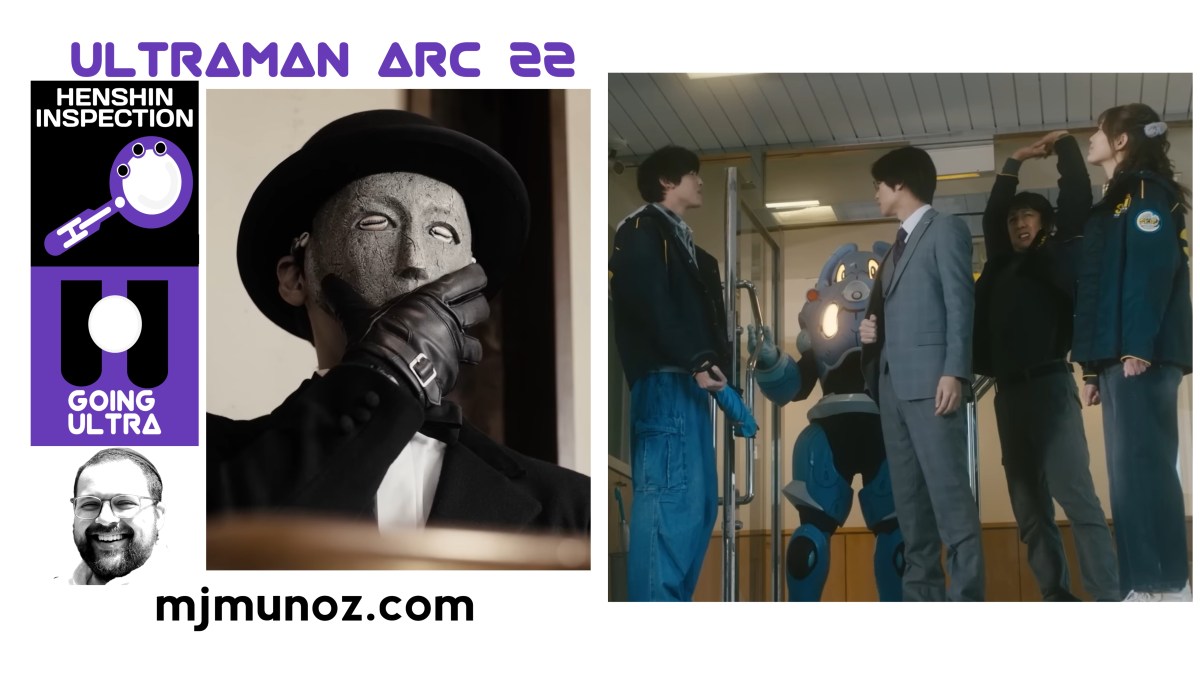
The episode draws heavily from surrealist art, particularly Belgian artist René Magritte. According to the Ultraman Wiki, several direct references appear:
- The Man in the White Mask’s appearance (a suit-wearing figure with a bowler hat) resembles figures from Magritte’s “The Meaning of Night”
- After the pillar disables Yuma’s Arc Cubes, we see silhouettes of pigeons filled with cloud imagery – directly referencing Magritte’s 1966 painting “The Skybird”
- The floating stone pillar bears resemblance to “The Castle of the Pyrenees”
- The nighttime street scene where Yuma seeks an umbrella was inspired by “The Empire of Light”
The production team achieved these effects through a combination of practical effects and digital work, creating a dreamlike quality that distinguishes this episode from others in the series.
Thematic Depth: Identity, Anxiety, and Erasure
Thematically, this episode delves into profound territory. The Man in the White Mask gave up his identity – his face and name – to gain power. This sacrifice allowed him to both escape his own anxiety and attempt to destroy anxiety caused by kaiju throughout the world.
His method involves erasing the memory and notion of kaiju, believing this would undo their existence. By targeting SKIP, he hopes to initiate a domino effect: if SKIP is erased and its members recast in different societal roles, this would facilitate erasing kaiju from memory, ultimately eliminating them entirely.
This concept attributes tremendous power to human perception and thought. It suggests our consciousness shapes reality – which connects to Yuma’s imagination being the key to his Ultraman powers. The episode presents an interesting paradox: the Man in the White Mask seeks to eliminate anxiety by erasing what causes it, yet this erasure creates a different kind of distress – the loss of self.
The Existential Horror of Identity Loss
The portrayal of characters after being “recast” is particularly haunting. Rin disappears when feeling depressed and tired, then reappears as a café waitress. Ishido, despite his strong will, confronts the Man in the White Mask and subsequently becomes a coffee bean delivery person.
Their movements become slow and mechanical – Yuma scrubbing tables or drawing with chalk outside – suggesting a zombie-like state. The performances effectively convey people who have lost their essence, becoming hollow shells going through the motions of existence.
This creates an atmosphere of existential dread. The episode seems to suggest that erasing what makes us anxious also erases what makes us alive. It’s a sophisticated exploration of depression and avoidance that resonates deeply.
Color as Metaphor for Life
The episode concludes with a powerful visual metaphor. When Arc defeats the kaiju with his rainbow blast, colorful drops fall from the sky, eventually transforming into rain. This imagery suggests that while anxiety (like rain) might be uncomfortable, it’s essential for life. Without rain, everything withers and dies.
Is the episode suggesting that stress, pressure, and even anxiety are necessary components of a meaningful existence? That removing all discomfort also removes what makes life vibrant? These questions linger long after the episode ends.
Production Notes
Masaya Honda, who wrote this episode, has also written for Ultraman Arc episodes “The Wandering Future” and the upcoming “Calamity Thrice,” along with work on Baruto (2017-2023) and Karas: The Prophecy (2005).
Director Tomonobu Koshi has directed several key Arc episodes including “Full Moon Dancer,” “The Light of Fear,” and “Demon Slicing Meteor Sword.” He was also assistant director for Ultraman Z.
The suit actor for the Man in the White Mask, Satoru Okabe, has portrayed several characters in Arc including Zongil, Givas, and Blazar.
Final Thoughts
“The Man in the White Mask” transcends typical tokusatsu storytelling, delivering a meditation on identity, anxiety, and the human condition. Its surrealist influences, minimalist approach to special effects, and philosophical underpinnings make it a standout episode that stays with you.
While less action-packed than other episodes, its thematic richness and visual artistry elevate it to something more akin to art cinema than standard tokusatsu fare. It’s an episode that benefits from multiple viewings and deeper contemplation.
I’d love to hear your thoughts on this uniquely crafted episode. Does it resonate with you as a meditation on anxiety and identity? Or do you see other layers to its meaning?
As always, you can find more of my work at MJMunoz.com and learn about my book featuring magical bugs battling monsters at Grobugs.com – a heroic story with bugs training to become stronger so they can protect children from creatures of darkness and chaos.
Until next time, take care and be well!
 MJ Muñoz