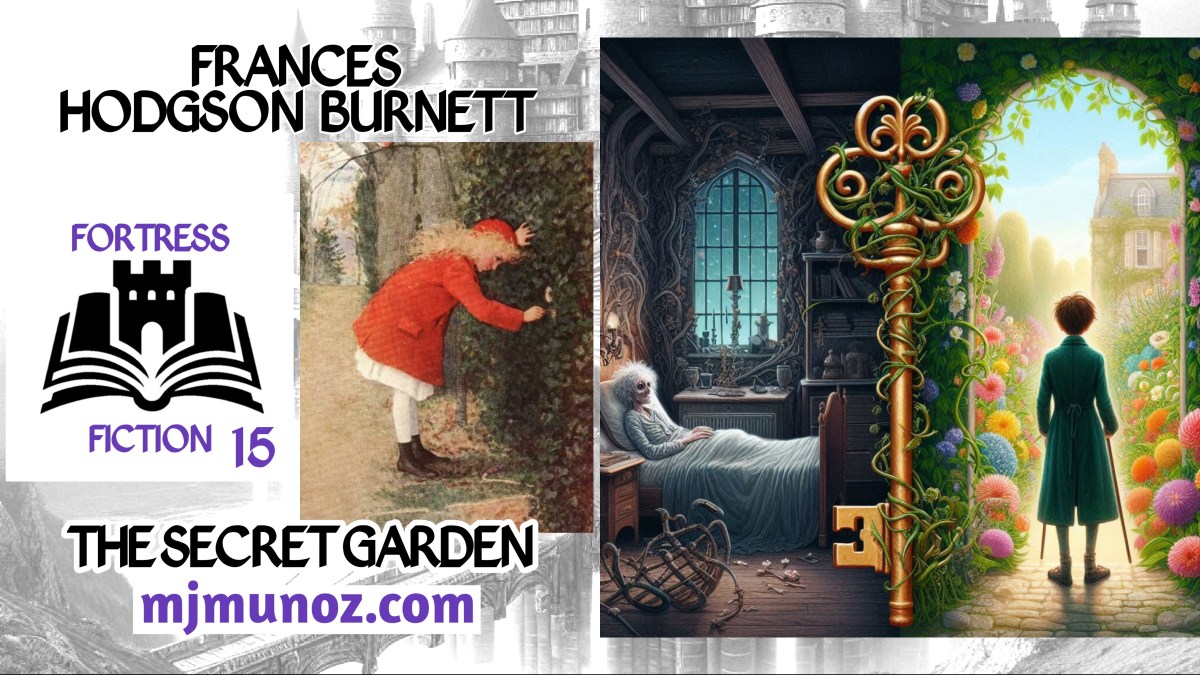
The Secret Garden: Where Magic and Science Become One – Fortress Fiction 15 – Fortress Fiction
What did you think of The Secret Garden by Frances Hodgson Burnett?
#amreading #middlegrade #bookreview #Book #TheSecretGarden #FOTRESSFICTION
VIDEO
How To Read
The book can be borrowed FREE from CloudLibrary and in audiobook format, or your local library AND Project Gutenberg and Librivox or purchased from the publisher’s site and many online retailers including in audiobook format as well from KOBO, audible.
The Secret Garden: Nature’s Magic Transforming the Human Spirit
By MJ Muñoz – Author, Artist, Analyzer – MJMunoz.com
The Secret Garden isn’t just a children’s story about a hidden paradise. It’s a masterful exploration of how nature’s magic transforms the human spirit from winter into spring. Published in 1911 by Frances Hodgson Burnett, this classic has captivated readers for generations—and for good reason.
Character Parallels and Contrasts: The Heart of the Story
Colin and Mary: Neglected Cousins
Colin and Mary parallel each other in multiple ways. They’re cousins whose mothers were sisters, both described as beautiful. Colin’s mother died when he was born, while Mary was orphaned when her parents died of cholera in India.
Before losing their parents, both children were extremely spoiled. Mary’s mother didn’t want her interfering with social activities, so she left her to be tended by nurses who let her become a tyrant. Colin’s father couldn’t bear to look at his son after his wife’s death, giving him things and people to tend to him, but never providing personal care.
Both grew up isolated from loved ones, controlling those around them, which damaged their character. Despite coming from families of great lineage and wealth, they were hollow inside—proving that you can have all the material goods in the world, but if you’re rotten to the core, nobody wants to be around you.
The Dickon Family: Rich in What Matters
Dickon’s family serves as a perfect foil to the Cravens and Lennoxes. Though they’re poor Yorkshire folk with crude speech, they possess what truly matters. Dickon’s mother is described as a great lady despite having no title or wealth. She’s raised twelve children with warmth and love, qualities Mrs. Medlock (the chief housekeeper) acknowledges as instrumental in healing both Colin and Mary.
The contrast is striking—Colin and Mary grew up with every material advantage but lacked love, while Dickon and his siblings grew up “cheek by jowl hungry” but were rich in family bonds. They were loved by parents present in body, spirit, and heart. Despite their poverty, they had the richness of family that Mary and Colin lacked.
Environmental Transformation: Mirroring Inner Growth
When Mary first arrives at Misselthwaite Manor, everything seems dead or dying. The moor initially appears as a bleak wilderness with deciduous trees showing only sticks instead of leaves, with haunting winds that frighten Mary. It felt almost like a gothic horror setting.
But looking back after finishing the book, I realize the real horror was inside Mary herself—she was empty, hollow, and lifeless like the moor seemed to be. Yet there was still life in the moor, just as there was still life in her.
The story establishes a powerful indoor/outdoor dichotomy. In India, Mary and her mother rarely went outside due to the oppressive heat and humidity. This made Mary yellow, sickly, and thin from lack of exercise and poor appetite. Similarly, Colin never leaves his room, believing the outdoors would harm him.
Yet as the seasons progress from winter to spring, so do the characters evolve. By the time Colin and Mary are well, it’s deep into spring—when Archibald returns and everything improves. The environmental rebirth perfectly mirrors their inner transformation.
Spiritual Dimensions: Magic and Divinity in Nature
Nature serves as both healer and divine messenger throughout the story. Dickon’s health and hardiness are attributed to his time spent on the moor—even the blue-gray color of his eyes is connected to him looking up at the sky so often.
The Robin acts as a divine messenger, guiding Mary to the garden key—how else would the bird have shown her where it was, if not for divine providence? How would Mary have found the garden door if not for that breath of wind (or spirit) that blew aside the vines just when she needed them to?
What fascinates me is how Burnett blends magic and Christian imagery as complementary rather than contradictory elements. Christianity isn’t explicitly mentioned until the final chapters, where a hymn is referenced.
Colin, despite being self-taught through books on science and nature, embraces the concept of magic. His perception of magic—as an unexplained phenomenon that is observable, reliable, and repeatable—blends seamlessly with spiritual concepts. He plans to become a scientific lecturer who teaches about “the nature of magic and the science of magic.”
There’s a Garden of Eden quality to the secret garden itself. After Colin’s mother fell from a tree branch and died, his father closed and sealed the garden—reminiscent of how Adam and Eve were banished from Eden with an angel guarding its entrance. Yet Mary is divinely guided to find her way back in, facilitating redemption and healing for Colin.
Symbolic Elements: Keys to Understanding
The hidden key to the garden unlocks not just the physical space but Mary’s transformation. Once she enters the garden, her life changes forever. Later we learn that Ben Weatherstaff had secretly tended the garden by climbing over the wall, unable to use the gate because the master had forbidden it.
Dickon acts almost as a cherubic figure—an animal charmer with seemingly supernatural qualities who guides Mary and Colin on their path to redemption. The Robin too serves as messenger and guide, with the bird’s perspective even given its own chapter near the end.
The concept of “the secret” becomes a powerful motif. Colin’s improving health becomes his passionate secret, which he initially keeps exclusive but eventually wants to share with everyone—his joy that he “will live forever,” that he’s whole and healthy.
Universal Appeal: Why It Endures
The Secret Garden speaks across religious boundaries. Though I approach it from a Jewish perspective and the book contains explicitly Christian elements near the end, I find no issue with this. The story is presented in such an open, optimistic, and welcoming way that it transcends specific religious frameworks.
The children’s perception of nature, magic, and spirituality seems rooted in an animistic worldview—the belief that objects, places, and creatures all possess spiritual essence. This perspective feels natural for children who haven’t been fully formed by conventional religious upbringing, giving the story universal appeal.
Burnett’s layered storytelling creates a reading experience that’s like walking through a garden, constantly surprising you with beautiful discoveries. Each time I consider the book, I find new dimensions to appreciate.
Final Thoughts
The Secret Garden absolutely deserves a place of high honor in the Fortress Fiction collection. I’ve encouraged my children to read it, offering to read it to them if necessary, because it’s that worthwhile. It’s a perfect family book that offers something valuable to readers of all ages.
I believe many people will love and benefit from this book if they haven’t discovered it yet. Its beautiful themes of transformation, healing, and spiritual awakening speak to universal human experiences in a way that remains fresh and meaningful more than a century after publication.
If you’d like to join me as I talk about other books, check out my backlog of Fortress Fiction episodes at mjmunoz.com. There, you’ll find discussions of wonderful books (and a few terrible ones, which I make no bones about criticizing).
A Personal Update: Mockwing Mayhem
I’ve been working hard on my debut middle-grade novel, Mockwing Mayhem. It’s about magical bugs battling monsters—specifically, a creature called a Mockwing discovers where the magical bugs live and aims to destroy them all. A couple of young, untrained Grobugs seize the opportunity to save one of their mentors and battle this misty bird monster that can hide in fog. IF they can defeat it they still have to survive the REST of the monsters!
The book is finished and I’m currently working with an artist on the cover. I’m aiming for a Summer 2025 release. If you enjoy stories like The Book of Three with real stakes, danger, and triumph over obstacles, I think you’ll enjoy my story too. The book doesn’t talk down to younger readers but addresses challenges in a meaningful way.
Sign up for my newsletter, where you’ll get announcements about the book’s release, exclusive offers, and free bonus material!
Until next time, take care and be well!
 MJ Muñoz