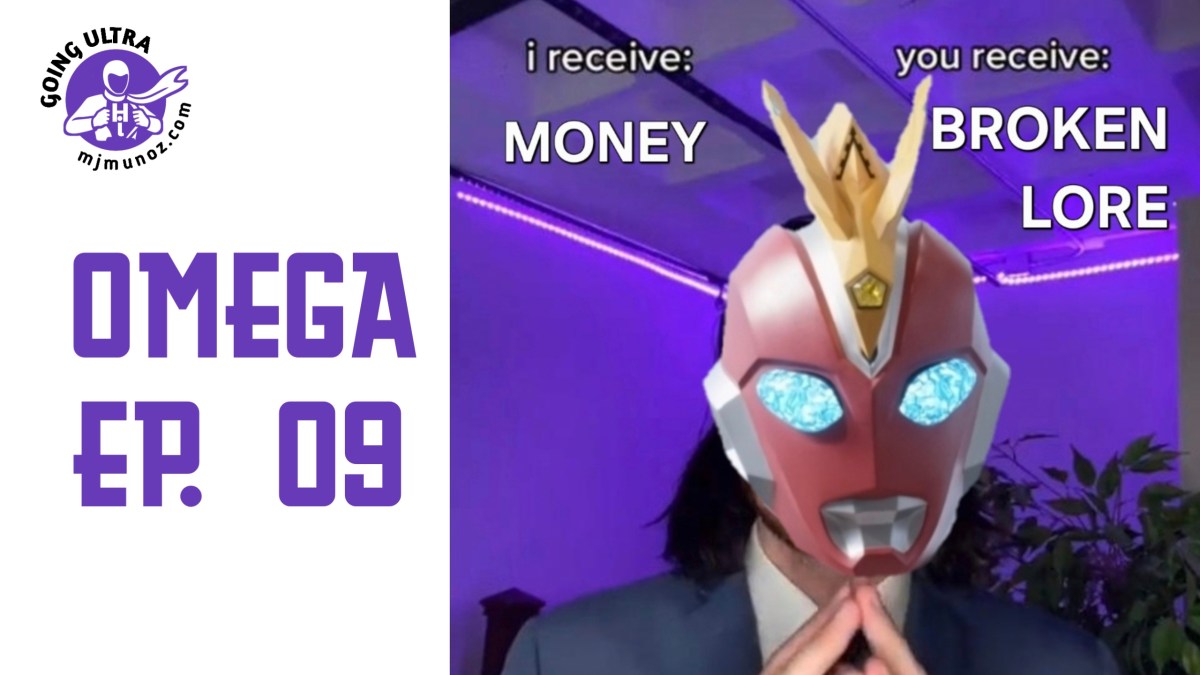
Ultraman Omega Episode 9 Broke Its Own Worldbuilding… Again – Going Ultra – Presented by Henshin Inspection
I just finished Ultraman Omega Episode 9, “The Kanenari Kaiju Park,” and I honestly don’t even know if it was worth talking about.
It feels like a waste of time.
It feels like my time was wasted watching it.
It feels like my time was wasted trying to analyze it.
And if you clicked on this review hoping to learn more about it, I’m not even sure that’s worth your time either.
Because Omega is not taking itself seriously.
And when a show doesn’t take its own premise seriously, that’s where everything starts to break.
The Premise Omega Promised Us
Here’s the official premise:
“On an earth where neither heroes nor kaiju exist, an alien suddenly falls from the sky…”
That’s what we were promised.
A world without kaiju.
A world reacting to kaiju for the first time.
A world that changes because of that reality.
We were supposed to see how society responds to the emergence of monsters and heroes.
That’s compelling science fiction.
That’s mythic.
That’s Ultraman.
But that’s not what we’re getting.
Omega 1 through 9 consistently violates the series’ own premise and doesn’t give us anything better in return.
And that’s the real problem.
This Isn’t About “Filler”
I’ve defended filler before.
Modern Ultraman has always indulged its science fiction roots. It gets weird. It tells morality tales. It goes on tangents. Sometimes those tangents are even two parters.
And somehow it still works.
Zett worked.
Blazar worked.
Arc worked.
Even when they stepped away from the main threat, their stories still felt internally consistent. They respected the world they built.
Omega doesn’t.
If the stories were excellent but didn’t quite fit the world, I might excuse it.
If the stories were brilliant but loose with the lore, maybe I’d let it slide.
But when the stories are bad and they don’t fit?
That’s inexcusable.
That’s insulting.
Respect for the Audience
Ultraman is made for children.
That does not mean it should be sloppy.
Children deserve good stories.
They deserve coherent worldbuilding.
They deserve internal logic.
Ultraman has historically been a prestige children’s franchise. It’s classier than most tokusatsu. It leans mythic. It leans science fiction. It aims higher.
Zett. Blazar. Arc.
They respected their premises.
Omega feels like it doesn’t.
And that’s disappointing.
Episode 9: The Breaking Point
Episode 9 pushed me over the edge.
Not because I can’t handle a weak episode.
But because I can no longer deny the pattern.
This is not one misfire.
This is structural negligence.
Or lack of care.
Or something else I have yet to identify.
The episode revolves around money, exploitation, and a kaiju theme park. There are ideas there. The direction is competent.
But the foundation underneath it all feels hollow.
And when your foundation is hollow, it doesn’t matter how flashy the armor is.
Ultraman Should Be Better Than This
I came to Ultraman after Kamen Rider and Super Sentai. I consistently praised it for being classier than Toei’s productions.
Comparing them is hard because they’re not trying to do the same thing. Kamen Rider and Super Sentai are comparable to each other. Ultraman is closer to science fiction. Maybe something mythic beyond that.
Omega had the potential to continue that tradition.
Instead, it keeps undermining itself.
I can’t believe people in the company are signing off on these weak Omega episodes. I want to know who is doing it and why.
Because this does not feel like Ultraman at its best.
Final Thoughts
Episode 9 made the pattern impossible to ignore.
If this is the direction Omega is choosing, then it’s a very different kind of Ultraman than what we were promised.
Am I crazy?
Or am I dead on?
Let me know what you think.
All Zeztz Analysis | All Omega Analysis | Project R.E.D. Analysis
Drop a comment below or tag me @MJ_Scribe on Twitter. Let’s have some fun talking about this.
If you enjoy thoughtful stories for kids and families, check out my book Mockwing Mayhem. Its a heartfelt adventure about magical bugs battling monsters and protecting children.
You can find more of my reviews, reflections, and stories with spine at mjmunoz.com, and join the mailing list there for behind the scenes updates and new releases.
Bonus
See This Toy? Buy Now!
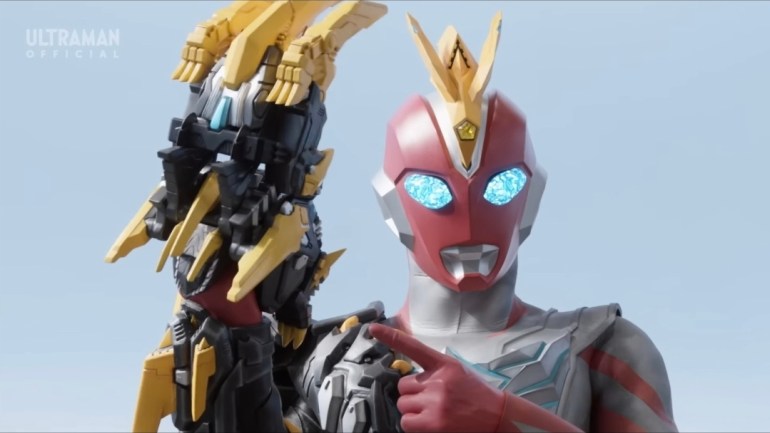
More than anything, I think the purpose of this episode was to finish out the two fold process of introducing the new toy: Trigaron.
I don’t know if the toy is a figure that turns into a claw for kids to brandish, or if the little mascot version of Trigaron is what is being sold, or if the armored form is the thing being advertised here. But it feels like it has to be one of those three.
What else could it be?
Trigaron functions as a cool savior in this episode in a three fold way.
First, the big guy shields civilians from the kaiju’s toxic spray by covering them with his own body. That is heroic imagery. It works emotionally.
Second, he attacks the kaiju directly to assist Omega. And I have to admit, this bit of action was striking.
Why?
Because we are watching two men in suits pretending to be quadrupedal monsters, and yet it does not feel cheap. Gubila is neat, though his design feels a little quaint. The front feet could look more like flippers, but instead they look more like shoes.
But Trigaron in combat?
I was impressed.
It does not look or feel like a guy in a suit.
I genuinely found myself wondering, how do they do that?
Of course, there is a great suit actor making it work. There are prop makers who had to enable him to move. There is choreography. There is camera work. There is physical endurance.
It is amazing to think about how much effort goes into making these fantastic worlds come to life.
Thank you for your hard work, Satoru Okabe, with Trigaron and so many other kaiju and Ultras.
And then comes the third part.
Trigaron turns into a claw and armor for Omega to use.
It quickly disables Gubila’s corrosive spray. Omega equips the armor. They go in for the finishing blow with the X Slash or whatever it is called.
In the moment, it felt like shallow salesmanship.
Slowing down and reflecting on it makes me even sadder.
Because what I am watching is not laziness from craftspeople. It is not incompetence from performers. It is not lack of effort.
It is a mountain of hard work.
And it feels like it is being used to say one thing:
See this toy?
Buy now.
 MJ Muñoz