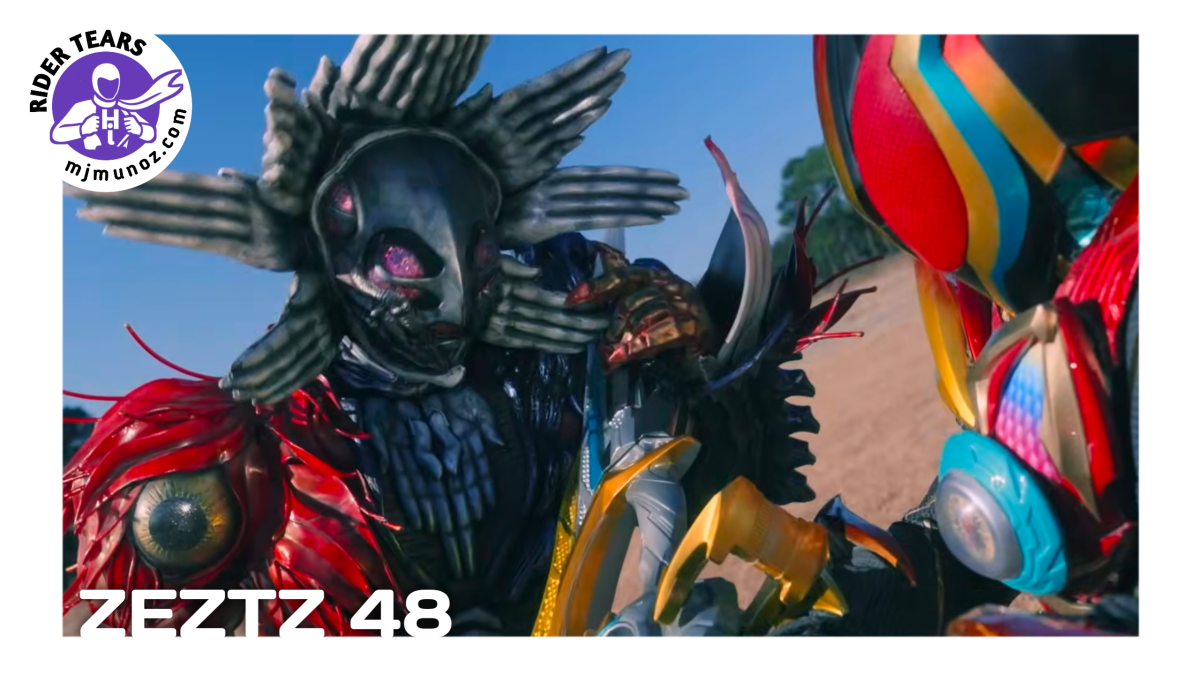

Kamen Rider Zeztz 48 – Rider Tears
Watch Analysis
The video and audio above contain the full unfiltered analysis. What follows is the razor focused version of the strongest point(s) I had to make.
Why Nem’s Sacrifice Feels Heroic and Wrong
I can’t believe they actually went there.
Kamen Rider Zeztz 47 had me worried about what was going to happen with Nem. I talked in my Inspector’s Notes about a moment where I thought Oblivion was planting the seed for Nem to kill herself, and sure enough, that’s basically what happens.
At the climax of Kamen Rider Zeztz 48, Nem walks across the water and through a door. Her identity starts disappearing, represented by her clothing giving way to pure white. Everything around her begins disappearing too. There are white flowers everywhere, and she’s holding a small bouquet of them.
It looks like she’s going away.
And the moment she does, Oblivion stops.
That’s when everyone realizes why. Oblivion has become overwhelmingly powerful because of Nem, following the same basic principle we’ve seen throughout Zeztz: Nightmares derive power from the people connected to them. We saw something similar with Catastrophe. As the person at the center of the Nightmare becomes more powerful, so does the Nightmare.
Oblivion has become so powerful that he’s shrugging off attacks, overpowering Dawn and Nox, and even Baku with his Extreme power can’t stand against him.
Then, just as Oblivion is about to kill Baku, he stops.
Nem is gone.
I thought that was absolutely fascinating, tragic and sad. I also don’t know how comfortable I am with it.
Baku Refuses to Save the World by Killing One Person
Part of what makes Nem’s choice so complicated is that Zeztz 48 directly gives us another answer to the same moral problem through Baku.
Baku is essentially presented with the argument that everything would be fine if Nem were simply gone.
He refuses.
If his goal is world peace and saving the world, how can deliberately murdering one person in order to accomplish that qualify as world peace?
I really like that moral stance.
You could easily imagine another character making the opposite decision. If Dawn decided that killing Nem was the terrible thing that needed to be done to save everyone else, for example, I would understand that dramatically. It would stand directly against Baku’s position. It would feel dark and maybe even villainous, but if it actually saved the world, there would be an uncomfortable utilitarian argument behind it.
Do the math. One person dies and the entire world lives.
Baku rejects the math because deliberately murdering that one person morally compromises the thing he’s supposedly trying to save.
But then Nem introduces a third possibility.
Nobody has to murder her.
She sacrifices herself.
Nem as the Nightmare Messiah
I’ve been calling Nem the “Nightmare Messiah,” and this episode makes that comparison considerably harder for me to ignore.
In the Christian understanding of a Messiah, the Messiah sacrifices himself so that others may live. Nem effectively does the same thing.
Before she disappears, she talks about the good memories she has of her friends, how blessed she’s been by all of these good dreams and dreams of all of them. To paraphrase the biblical language, there is no greater love than to lay down your life for your friends.
That’s effectively what Nem is doing.
And weirdly, that feels better to me.
Someone murdering Nem because the numbers say her life is worth less than the entire world feels wrong. Baku refusing to murder her feels morally right. But Nem voluntarily saying, Fine, I’ll give myself so that everybody else can live feels noble.
You kind of can’t make the same argument against it because it’s her choice.
Except I still think there’s something wrong here.
The Difference Between Sacrifice and Erasing Yourself
This is where Kamen Rider Zeztz 48 makes me genuinely uncomfortable.
Nem isn’t simply a hero throwing herself in front of an attack to save somebody else. She’s a Nightmare who believes she was never supposed to exist in the first place. By removing herself, she can seemingly make the equation balance again.
And I really don’t like the possible implication of that.
Taken by itself, it gets dangerously close to saying that if everything is wrong because of you, removing yourself might be the answer.
I don’t think that’s what Zeztz ultimately intends to say. I don’t think Nem’s story is actually finished here, either, and the next episode may completely change how this moment needs to be understood.
But in this episode, the imagery gives her choice nobility. Her disappearance saves everyone. The story demonstrates immediately that her sacrifice works.
That’s why I’m conflicted.
I appreciate the tragedy and heroism of what Nem does while simultaneously being uncomfortable with the mechanism the story uses to express it. I think it’s a little dodgy. Out of context, I think the message could be pretty bad, although a lot of things become bad when you remove their context.
So I don’t want to judge the entire idea before Zeztz finishes it.
But I do want the show to finish it.
The Lady and Phantom Gore Nightmare Are Still Confusing Me
There’s another complication in all of this involving The Lady and the Phantom Gore Nightmare.
When we return to where Nox is being held, he’s physically restraining the Phantom Gore Nightmare in her monster form. Once she realizes that Nox is going with Dawn to try to destroy Oblivion and save Nem, she cooperates.
More importantly, when Nem talks as though everything could be fixed if she were simply gone, the response is essentially: don’t do that.
That seems to suggest a desire to protect Nem.
But that creates a conflict with the earlier argument presented to Baku that getting rid of Nem would solve everything.
I’m still unsure exactly how The Lady and Phantom Gore Nightmare’s identities are functioning in relation to each other. Was one statement coming from The Lady and the other from the Nightmare? Are their desires different depending on which identity is dominant? Or is this simply an inconsistency?
I don’t know.
Right now, it’s unclear enough that I think it’s a stumble.
Sieg Is on the Path Toward Redemption
I also really liked Nem’s conversation with Sieg.
I still don’t think Sieg has completely earned his redemption, but he’s definitely on the path toward it. I’m happy that he’s back, and weirdly, I kind of hope he gets to stick around.
I don’t know how Yuya Takahashi gets things to work out this way. Although maybe some of the credit belongs to Ryutaro Akimoto, because Sieg is charming enough that despite everything that’s happened, I find myself wanting him to stay.
That’s a strange place to end up with this character, but I’m enjoying being there.
Zeztz Has Gone From Saving the World to Saving One Person
Despite how uncomfortable Kamen Rider Zeztz 48 made me, I really enjoyed it.
One of the most interesting things about this final conflict is how the scale has almost inverted. We’ve gone from saving the world to saving one person.
The whole world is statistics.
One person is somebody you can wrap your mind around and care about.
That’s why Nem deciding that it was time for her to go made me so sad. I couldn’t believe the show was actually doing it.
And with only Kamen Rider Zeztz 49 and 50 remaining, that single life may now be the emotional center of the entire ending.
There’s also one question I barely touched on that could make this even more complicated: Baku is getting weaker from entering the dream directly. What happens if he ultimately sacrifices himself to save everybody?
Would that feel okay when Nem sacrificing herself doesn’t?
Is there actually a moral difference between saying, “I’m the problem, so I’ll erase myself” and saying, “I’m going to keep fighting to save everyone, even if it kills me”?
Those feel profoundly different to me.
I’m still trying to figure out exactly why.
And I think that’s why Kamen Rider Zeztz 48 worked on me as well as it did. It made me sad. It made me uncomfortable. It gave me several moral positions that conflict with each other, and it hasn’t given me an easy answer yet.
With two episodes left, I’m hoping it doesn’t.
Inspector’s Notes
Are Nightmares the Price of Having Dreams?
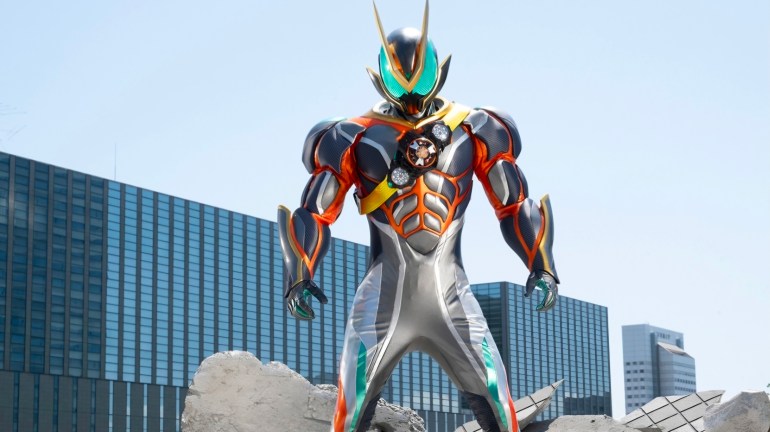
I’ve been thinking about the relationship between dreams and Nightmares in Kamen Rider Zeztz, and I keep coming back to this idea: because there’s light, shadows are cast.
So shouldn’t there be something similar between dreams and Nightmares?
If Nightmares are just monsters that cause murder and mayhem, and there’s no overall utility to them, then they should be eradicated. And yes, I am advocating for a Nightmare genocide if that’s what they are. If they’re truly just evil, preying upon humans because they can, then what else are you supposed to do with them?
But I don’t think that’s as interesting as what Zeztz sometimes seems to be suggesting.
Maybe Nightmares are an evolutionary force that adds pressure to humanity. Humans advance, Nightmares grow more powerful to push back against them, and then humans have to advance again to overcome the Nightmares.
Maybe they’re there to give humanity hardship and pressure that causes people to grow, evolve, and become better and stronger.
I would prefer something even more Jungian, almost like Persona, where the Nightmares are shadows of the true self. You have your dreams, which are your ambitions, your hopes, and the things you want to happen. On the other side of that are your fears, your Nightmares, the things that could stop those dreams from happening.
Then the answer isn’t simply destroying your Nightmare.
You have to learn not to be afraid of it. You can’t let the fear of failure overwhelm you and overcome you. You have to learn how to live with it.
And the strange thing is that Baku and Nox have already done versions of this.
Baku creates Inazuma by embracing and overcoming his Nightmare in the Premonition, and his relationship with Catastrophe ultimately becomes part of his power with Catastrom and Extreme.
Nox does something similar with Midnight Shadow. Odaka chooses to embrace the darkness he was afraid of and use it to give himself power.
Those things make sense to me.
In fact, I think Baku’s power of Catastrophe, and ultimately Extreme, along with Nox’s power of Midnight Shadow, should be the answer to the problem the series presents: What are humans supposed to do about Nightmares?
Maybe you’re supposed to integrate your Nightmare into yourself, learn from it, overcome the challenges it presents, and learn how to act in your life without being shackled by fear.
Because maybe the Nightmare is the price of being able to have the dream.
If there’s no chance of failure, then achieving your dream is meaningless.
That fits my own theology. Humans have free choice, which means we have to actively choose righteousness and choose to love and serve God. He gave us that choice knowing full well that we could reject Him. But the possibility of rejection, of choosing sin and choosing the wrong path, is part of what makes choosing the right path meaningful.
We can choose separation. We can also repent, return and say, I don’t want to be disconnected from You anymore. I did that before. I don’t want to do it again.
If we didn’t have the choice, it wouldn’t be meaningful.
Maybe dreams and Nightmares work the same way.
A thing can be precious and beautiful partly because it is fleeting. Achieving a dream means something because achieving a dream takes work. If there were no hardships to overcome, no possibility of failure, no things that could turn your dream into a nightmare, then maybe dreams wouldn’t matter as much.
We need struggle.
I believe things happen for us, not to us, and the challenges we face are part of our journey and part of the process of getting where we need to be.
So maybe that’s what Nightmares should mean in Zeztz.
The problem is that I don’t know if that’s actually what Zeztz is saying.
The show has been purposefully vague enough that I don’t think I have the evidence I need to say this is the ending it has earned.
It’s the ending I wanted it to earn.
It’s the ending that feels right to me. It matches my sensibilities as a writer, as somebody who likes logic, and as somebody who isn’t a theologian but understands his own theology. It would make everything internally consistent.
But then I have to deal with Black Cases.
If dreams can become reality, then Nightmares can become reality too. That makes sense. The problem is that capital-N Nightmares become actual beings with sentience. They use people as doorways to enter the world, cause destruction, and create Black Cases.
That feels like something different from simply being afraid that your dream might fail.
Maybe that’s where the balance has gone wrong.
Maybe people are supposed to have fears. Maybe they’re supposed to have struggles and things they need to overcome in order to achieve their dreams. But those fears aren’t supposed to become literal monsters that require a Kamen Rider to enter someone’s dream and fight them.
And then there’s Nem.
Nem is born from a Nightmare, but she becomes a person who wants to make sure the world can be a place where people’s dreams can come true.
Not a world where everybody gets everything they want instantly.
A world where people can dream, period.
Maybe she wants to make sure people can pursue those dreams without the risk of literal capital-N Nightmares using them as doorways into the world to cause destruction, ruin, and Black Cases.
That makes me wonder if Nem could somehow be the bridge.
Maybe the answer isn’t eradicating Nightmares. Maybe it’s restoring some kind of balance so that people can deal with their own fears and struggles, with help from their friends and loved ones when they need it, without requiring a Rider to come battle a literal monster inside their dreams.
But that’s me trying to make all of these pieces fit.
It’s not something I can confidently say Zeztz has established.
And I think that’s ultimately where I am with the Nightmare cosmology of Kamen Rider Zeztz.
If Nightmares are simply evil monsters, destroy them.
But if Nightmares are the shadows cast by our dreams, if they’re the fear and struggle created by having something worth striving for in the first place, then destroying them can’t be the answer.
You don’t get the shadow without the light.
And maybe you don’t get the Nightmare without the dream.
Loose Thread
Why the Final Battle Is Making Strange Bedfellows
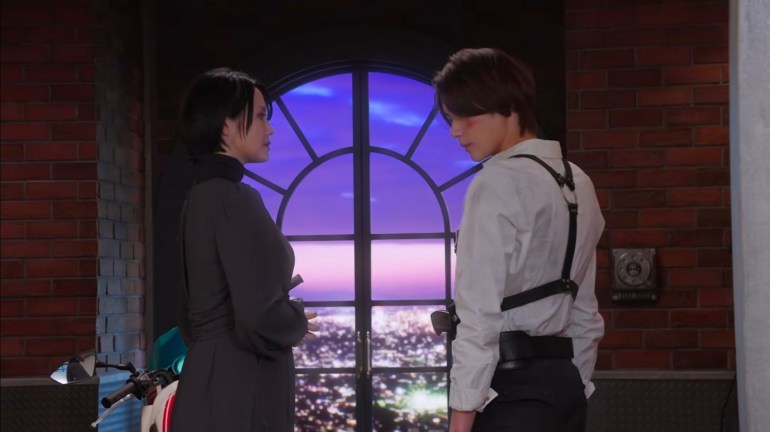
Kamen Rider Zeztz 48 has strange bedfellows all over the place, but there’s one shot that really embodies it for me.
Baku is standing in the Zeztz Room with The Lady, looking out over this darkening, dusky sky. The Lady is a former CODE agent, a rogue who became bonded to a Nightmare. Baku is a rogue CODE agent who also formed a bond with a Nightmare when he was an infant, which I still don’t know how the heck that happened, but it happened.
The difference is that Baku overcame his Nightmare. The Lady has effectively been consumed by and fused with hers.
And now they’re standing together in the Zeztz Room.
It’s especially interesting because the Zeztz Room shares architectural details with The Lady’s domain, particularly those big windows. She has spent so much time standing by her window, looking mysterious, while Baku has spent so much time going through his window to deploy himself into people’s dreams and save them from Nightmares.
They’ve been standing on opposite sides of similar windows for most of the show.
Now they’re standing at the same one.
The Lady has effectively been one of the bad guys throughout Zeztz, but her motivation has always been more complicated than simply wanting bad things to happen. CODE wanted to take baby Nem away from her and do who knows what with her. The Lady protected her daughter, and right or wrong, her actions make sense after a fashion when you look at them from her perspective. She tolerated the Nightmares and caused trouble for CODE because she wanted to protect Nem, eventually find her, wake her up, and be together again.
Now she’s fused with the Phantom Gore Nightmare, and the line between The Lady and Phantom has gotten increasingly difficult for me to parse.
But in this final arc, even she pauses what she’s doing to let Odaka go so he can team up with Sieg against Oblivion.
That’s another pair of strange bedfellows.
Sieg is someone The Lady never trusted and worried would ruin her plans. He’s also a former criminal who has continued to carry at least the persona of a villain, although I’ve always thought he’s more complicated than that. He was a killer of killers.
And supposedly noble CODE was sending him to kill those killers.
So aren’t they just as bad?
You could certainly imagine Sieg arguing that they are. CODE is a defense organization that was using a killer to kill killers in the name of peace from before the story even began. Does that make CODE rotten from its inception, or was that a necessary evil?
I’m not going to answer that right now. I’m just putting the question out there because it makes the alliances forming at the end of Zeztz even stranger.
We have Nox and Sieg fighting together. We have The Lady and Baku standing together in the Zeztz Room. Characters who have spent most of this story on opposite sides are suddenly being pushed together against Oblivion.
And Baku and The Lady might be the most interesting pair.
He overcame his Nightmare. She fused with hers.
The Lady went years without sleeping. Now Baku is pushing himself without sleep.
He’s kind of going down her path.
Maybe Baku has become something of a Nightmare himself. Or maybe he’s become a dream. I don’t know. He’s definitely become Extreme, and he’s taking extreme measures, if you’ll forgive the pun.
Either way, here they are: dream and Nightmare, so to speak, united against another Nightmare whose effects are going to be much worse.
And maybe the name Oblivion tells us why.
If we take that name literally, oblivion is forgetfulness, erasure, even nothingness. So heroes and villains, people on completely different sides of the conflict, are ultimately fighting against annihilation.
At that point, the alliance makes sense.
Whatever cosmological, theological or ideological truths are underneath Zeztz, whatever the ultimate relationship is between humanity, dreams and Nightmares, you can put all of that aside temporarily when one Nightmare is threatening to destroy everything.
An extinction-level threat makes strange bedfellows.
What I find fascinating is that I’m still not sure why Zeztz wants its final conflict to take this particular shape.
I enjoy it. I find it emotionally affecting. I think these alliances make sense given the enemy everyone is facing.
But I also find it strange.
Is Yuya Takahashi punting because he doesn’t want to write a more direct ideological conflict between humans and Nightmares? Or is collapsing all of these old battle lines actually the point?
Because with the end of Zeztz approaching, I’m still wondering why we aren’t getting the more straightforward conflict between Nightmares and humans that I once assumed the story was building toward.
Maybe the fact that we aren’t is telling us something.
I’m just not sure what yet.

