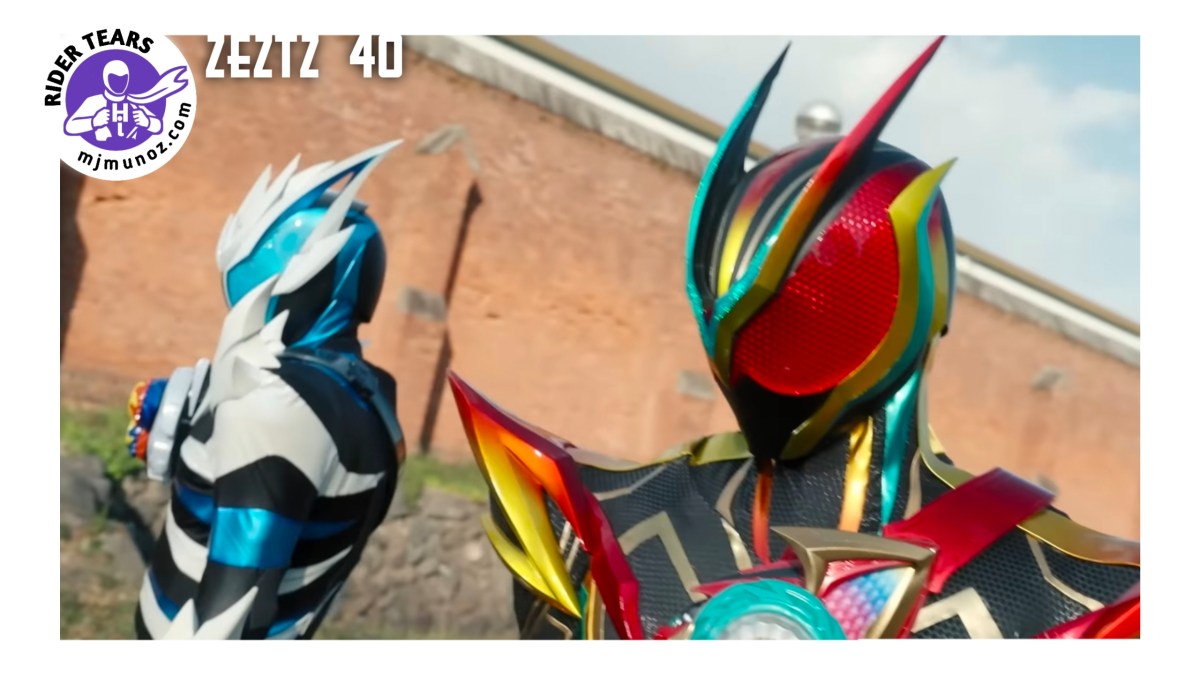

Kamen RIder Zeztz 40 – Rider Tears
Watch Analysis
The video and audio above contain the full unfiltered analysis. What follows is the razor focused version of the strongest point(s) I had to make.
Kamen Rider Zeztz 40 Is the Sloppiest Episode of the Series So Far
Kamen Rider Zeztz 40 is the sloppiest episode of the show we’ve had so far.
I enjoyed moments in it, but the overall story didn’t land for me as well as it could have. Like the previous episode, this one felt like setup. Worse, it felt like insufficient setup. Poorly executed setup.
I feel like people are being moved around the board, and it just isn’t as entertaining as it could be.
What’s frustrating is that I’ve been such a diehard Takahashi fan and such a diehard Zeztz fan all along the way. This isn’t coming from someone who wants the show to fail. It’s coming from someone who has spent forty episodes rooting for it.
The problem isn’t that Episode 40 lacks ideas.
The problem is that it feels like the show is introducing revelations, moving characters, and setting up future developments without properly connecting them to each other.
Setup Is Replacing Story
For the second episode in a row, it feels like we’re moving pieces into position rather than telling a compelling story in the present.
Characters are being repositioned.
New threats are being introduced.
Relationships are being adjusted.
Mysteries are being expanded.
But very little of it feels satisfying on its own.
A setup episode can still be a great episode. Some of the best episodes in serialized storytelling are setup episodes. The trick is that the setup itself still has to be entertaining.
Here, too much of the episode feels like it’s focused on getting pieces where they need to be for later rather than making the current episode compelling in its own right.
Zeztz 40 Keeps Introducing Answers That Create Worse Questions
The biggest example is the reveal surrounding the CODE: Somnia Capsem.
At the end of the episode, Baku realizes that Punish Gore Nightmare never had it. That’s presented as a major revelation. Then we discover that the baby Nightmare was the real holder all along.
The problem isn’t the reveal itself.
The problem is everything that immediately follows.
How did the baby Nightmare get the Capsem?
Did Phantom Gore Nightmare retrieve it?
Did Catastrophe Gore Nightmare retrieve it?
How does this connect to The Lady?
How long has this been going on?
The reveal doesn’t feel like a piece clicking into place. It feels like another piece being tossed onto the table.
The same thing happens when the baby Nightmare evolves into Oblivion Gore Nightmare.
That’s an interesting development.
But instead of clarifying the mythology, it makes me start asking new questions.
Now we have Phantom, Catastrophe, Punish, and Oblivion.
That immediately makes me think about the old hierarchy of CODE. It feels like there should be some connection there. Maybe there is. Maybe there isn’t.
The episode doesn’t really tell us.
Even the mechanics of CODE: Somnia remain frustratingly vague.
Apparently it connects dreams together.
Apparently it allows people to be forced into certain roles inside those dreams.
Apparently it can affect the entire dream network.
I guess.
But what are the actual rules?
At this point in the story, I don’t want less clarity. I want more.
The moon imagery feels like it should connect to the dream world. The Capsem feels like it should connect to Nem. The Lady feels like she should connect to what’s happening with the Nightmares.
Everything feels adjacent.
Very little feels connected.
Had this been handled more deftly, the mysteries could still exist. The revelations could still happen.
But instead of feeling intrigued, I mostly felt confused.
The Dream World Is Making the Story Harder to Follow
The other major issue is Baku getting shot and immediately entering the dream world.
On paper, that’s fine.
We’ve seen similar things before. When Baku created the Ex-Dream Driver, his consciousness entered the dream realm. So if being critically injured sends him there again, I can accept that.
The problem is what the episode does with it.
Once Baku arrives, he’s having conversations with Nem and Sieg that could have happened under entirely different circumstances.
He didn’t need to get shot again.
He didn’t need to be dying again.
He didn’t need another trip to the edge just to facilitate those scenes.
Instead, the episode creates a situation where real-world events and dream-world events are happening simultaneously, and I found myself spending more time trying to track where everyone was than focusing on the drama itself.
At several points I was wondering:
Wait.
What’s happening?
Where is Baku?
Is Zeztz about to appear next to his own unconscious body?
The episode eventually answers those questions.
The problem is that I was asking them in the first place.
More importantly, it feels like we’ve drifted away from some of the original stakes of the series.
Early on, we were told that if a Nightmare successfully used a person, that person could become a gateway for the Nightmare to enter reality and make nightmares come true.
That was terrifying.
That was clear.
That created immediate stakes.
Now it feels like we’re spending so much time inside dream mechanics that the original premise has become blurry.
Maybe the rules haven’t changed.
Maybe I’m forgetting something.
But if I’m asking whether the show has forgotten its own rules, that’s a problem.
Character Scenes Feel Like Plot Maintenance
My final frustration is Sieg.
I don’t understand what these scenes are accomplishing.
Sieg says he isn’t going to change.
He continues acting villainously.
He’s happy when Nem gets hurt.
So what exactly are we doing here?
Is this a Sieg scene?
A Nem scene?
A Baku scene?
Some combination of all three?
I genuinely couldn’t tell.
The information being delivered isn’t necessarily bad. The performances aren’t bad. The scenes themselves aren’t even bad in isolation.
They just feel like they’re happening because the plot needs them to happen.
Nem’s compassion could have been demonstrated elsewhere.
Sieg’s attitude could have been reinforced elsewhere.
The same information could have been delivered in a cleaner and more focused way.
Instead, the scenes contribute to the overall feeling that things are happening in the wrong order.
Final Thoughts
The frustrating thing about Kamen Rider Zeztz 40 is that I can see the ideas.
I can see what Takahashi is trying to set up.
I can see future episodes where these revelations, character moments, and mythology developments pay off.
But Episode 40 asks me to spend a lot of time with pieces that don’t feel fully connected yet.
The result is an episode that feels sloppy.
Not because nothing happens.
Not because there aren’t good ideas.
But because too much of the episode feels like moving pieces around the board without properly connecting them.
The revelations create bigger questions than they answer.
The dream mechanics are less clear than they should be.
The character scenes feel more like maintenance than development.
For the first time in a long while, Zeztz feels like it’s stumbling rather than building momentum.
Maybe all of these threads come together beautifully in the end.
Right now, though, Episode 40 feels like setup replacing story.
What are your thoughts?
Was Episode 40 genuinely sloppy, or do you think all of these pieces are about to come together in a satisfying way?
Drop a comment and let me know where you stand on this.
Inspector’s Notes
Should Kamen Rider Allies Have Powers?
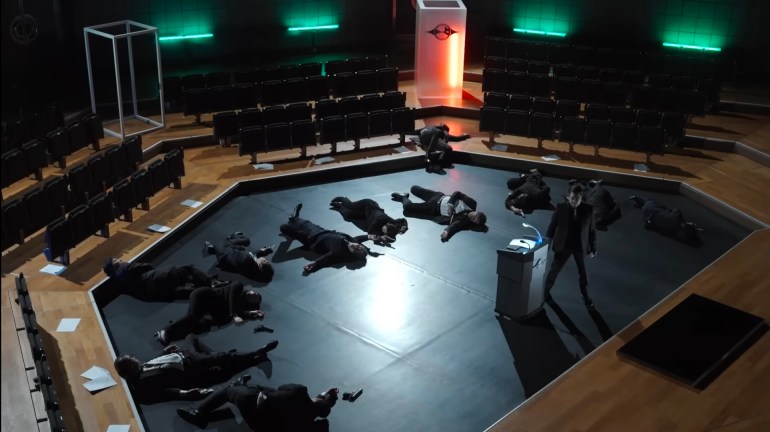
One of the coolest moments in Zeztz 40 is almost a blink-and-you-miss-it moment.
Zero uses the Zero Rider Booster and suddenly he’s basically the Flash for a few seconds, taking down a room full of opponents before they can react.
What’s funny is that Baku’s original power-up was Plasma, which also basically let him become the Flash. So there’s a little bit of a father-and-son thing going on there.
More importantly, it got me thinking about something.
We don’t get a lot of instances of non-Rider characters getting to have superpowers and actually doing things with them.
Back in the original Kamen Rider, allies would sometimes fight Shocker grunts. They’d try to fight monsters too, but they would always fail—and for good reason. The monsters were Rider-level threats.
Here, though, we get to see a non-Rider display real power.
I wouldn’t say that’s absolutely unique to the framework of Zeztz, but the Capsems definitely make it easier. They create a mechanism where civilian characters can have powers without becoming Riders themselves.
The question is whether that’s actually a good thing for the story.
I honestly don’t know.
Obviously, it can be handled well, and it can be handled poorly.
I can think of plenty of times when I wanted to see Rider allies have some sort of limited power. Take Kamen Rider Wizard. Why couldn’t Rinko have had silver bullets or some kind of anti-Phantom equipment? Not enough to replace Haruto, but enough to hold the line, help civilians, or get herself out of trouble until the Rider arrived.
That’s the interesting balance.
Giving allies powers can make them feel more useful and more active in the story. At the same time, part of the appeal of Kamen Rider is that the Rider can do things nobody else can do.
Zeztz 40 doesn’t answer that question, but Zero’s speed burst raises it.
Do you want Rider allies to have some sort of limited power that they can use to help the hero or get themselves out of jams?
Or is it better when the Riders are the only superhuman heroes in the story?
It’s an interesting question, and I’m honestly not sure what the right answer is.
What Is the Point of Nem?

Zeztz 40 has this interesting conversation between Nem, Baku, and Sieg. Nem gets to play the role of nurse or doctor in the Zeztz Room and save Baku from the bullet he got shot with, which gives her some immediate plot utility.
But it made me think:
What is Nem’s overall point in the show?
What is she supposed to be used for?
She’s been a damsel in distress many times. She’s had moments where she’s shown some measure of power. She’s had moments where she’s helped Baku. I mean, I guess all along she’s helped Baku.
But what is her role in the story overall?
There’s this whole idea—mostly my idea—of her potentially being some sort of Nightmare Messiah. Then we see her being affected by the Baby Nightmare evolving into Oblivion. That feels important. It feels like there should be something there.
And yet I’m still not sure what the point is of Nem in the show.
She’s entertaining to watch. Not because I like looking at her. She’s charismatic and does good and interesting things in the show.
But when I step back and ask why she’s here, I don’t know.
It’s almost like, for lack of other choices, she and Baku have to interact with each other in the dream because who’s else there for him to interact with on a regular basis?
Nox, pretty much.
Through thick and thin she’s been there with him. She’s always been his partner on things.
So is that her role?
Is she there so Baku has somebody to talk to in the dream world?
Is she there to give him context?
Is she there because somebody has to be his partner in that space?
Or is there something more going on?
We’re forty episodes into Zeztz, and Nem is the character I still feel like I’m trying to figure out.
Maybe that’s intentional.
Maybe Oblivion’s connection to her is finally the beginning of an answer.
Or maybe her role has been right in front of me the whole time and I just haven’t seen it.
Either way, it’s one of the biggest questions I have about the show right now.
What do you think? What is Nem’s actual purpose in the story of Kamen Rider Zeztz?
Is Sieg Nem’s Foil?
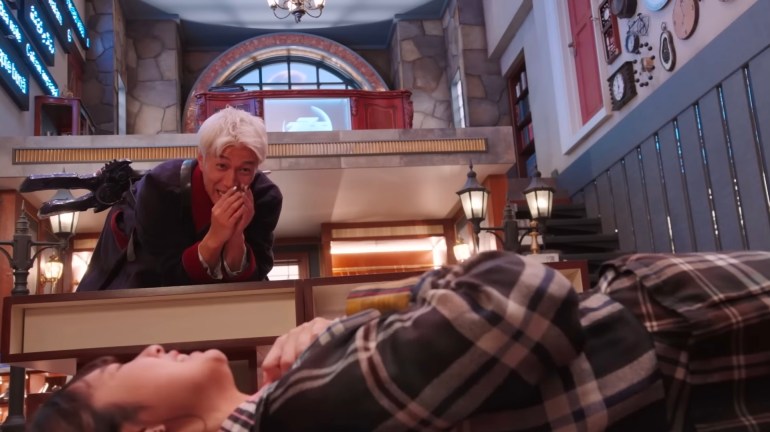
The interactions between Sieg and Nem in Episode 40 made me wonder something.
Even though I don’t necessarily know what Nem’s deal is in the show, it seems clear to me that Sieg is supposed to be her foil.
Why do I say that?
Nem is a Nightmare person, just like Sieg is. She was born because Agent One had a dream about having a baby, and Nem was born by the power of Nightmares. Sieg was also an agent, but he became so corrupted, twisted, and dark that he fused with a Nightmare.
So they’re both Nightmare people in a way.
What’s interesting is that they’re complete opposites.
Sieg is incredibly pessimistic. He wants to see people punished. Even now, he seems happy when bad things happen to people. He doesn’t believe people change. He doesn’t believe people deserve another chance.
Nem is the opposite.
She’s consistently optimistic. She wants to see people redeemed, saved, helped, and healed. Even in Episode 40, she’s talking about giving people a chance to do right.
The more I think about it, the more it feels like that’s the real contrast between them.
It’s not just that they’re both part human and part Nightmare.
It’s their view of humanity.
Sieg looks at humanity and sees something broken that deserves punishment.
Nem looks at humanity and sees something worth saving.
That’s why I think he might actually be Nem’s foil.
Which is a little strange.
You would think Sieg would be Baku’s foil instead. They’re rivals. They’re constantly bouncing off each other. They’re the ones who end up in conflict.
But I don’t think he really is.
At least not in the way a foil usually works.
When I look at Sieg and Nem, I see two characters who came from similar circumstances and arrived at completely opposite conclusions about people.
And that’s a much cleaner foil relationship than anything Sieg has with Baku.
I don’t know if that’s what the show is intentionally doing.
But after Episode 40, it’s hard for me not to see it.
What do you think? Is Sieg actually Nem’s foil, or am I reading too much into the way these two characters are being contrasted?
Why Commit to THIS Bit?
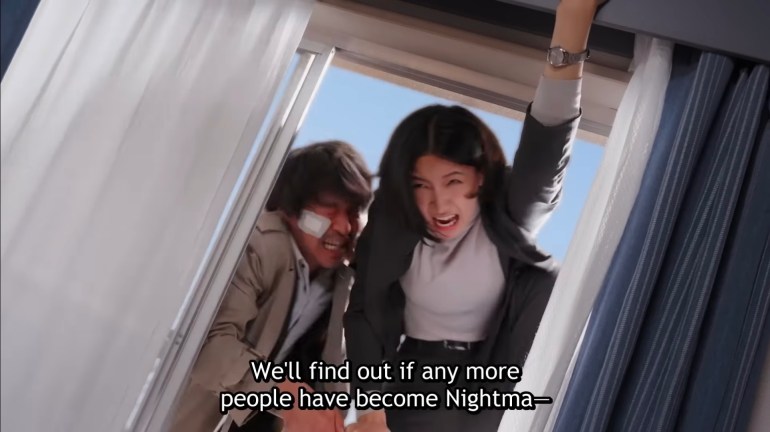
It’s Episode 40. The stakes are getting higher, I guess, if they can get higher in this show. I mean, we almost had the entire planet destroyed already, so I’m not sure the stakes can actually get much higher.
And yet here we are, still doing the bit where Fujimi and Nasuka keep climbing in and out of Baku’s bedroom window.
It’s so bizarre.
This bit happened inside the premonition originally, and it just keeps happening. At this point, I want to know why they’re committing to it.
I don’t have a problem with goofy humor being in my henshin hero shows. I don’t even know how I feel about slapstick overall. Sometimes it’s enjoyable. Sometimes it’s not. Does slapstick automatically bring something down? I don’t think so.
At least not necessarily.
And honestly, I enjoy this bit.
That’s the funny thing.
I enjoy it, but I also keep asking why they’re sticking with it.
Why this one?
Why this joke?
Why this long?
There have been plenty of recurring gags in Kamen Rider over the years, but most of them either fade away or evolve into something else. This one just keeps showing up.
It’s become part of the show’s DNA at this point.
Maybe that’s the answer.
Maybe the writers simply found a joke they liked and committed to it.
Maybe it works because it’s so unnecessary. Nobody needs to be climbing through Baku’s bedroom window. There are doors. We all know there are doors. That’s what makes it funny.
It’s also been a while since Nasuka kicked Fujimi.
That could happen again at any time.
Maybe that’s part of the appeal too. The show has trained us to expect some variation of the joke whenever these two show up at the window.
I don’t know.
I just find it fascinating that, forty episodes in, with endgame plotlines, Nightmares, CODE, and the fate of the world hanging in the balance, this is the bit they’ve decided to keep bringing back.
And somehow it’s still here.
What do you think? Do you enjoy Fujimi and Nasuka climbing through Baku’s window, or has the joke run its course?
 MJ Muñoz