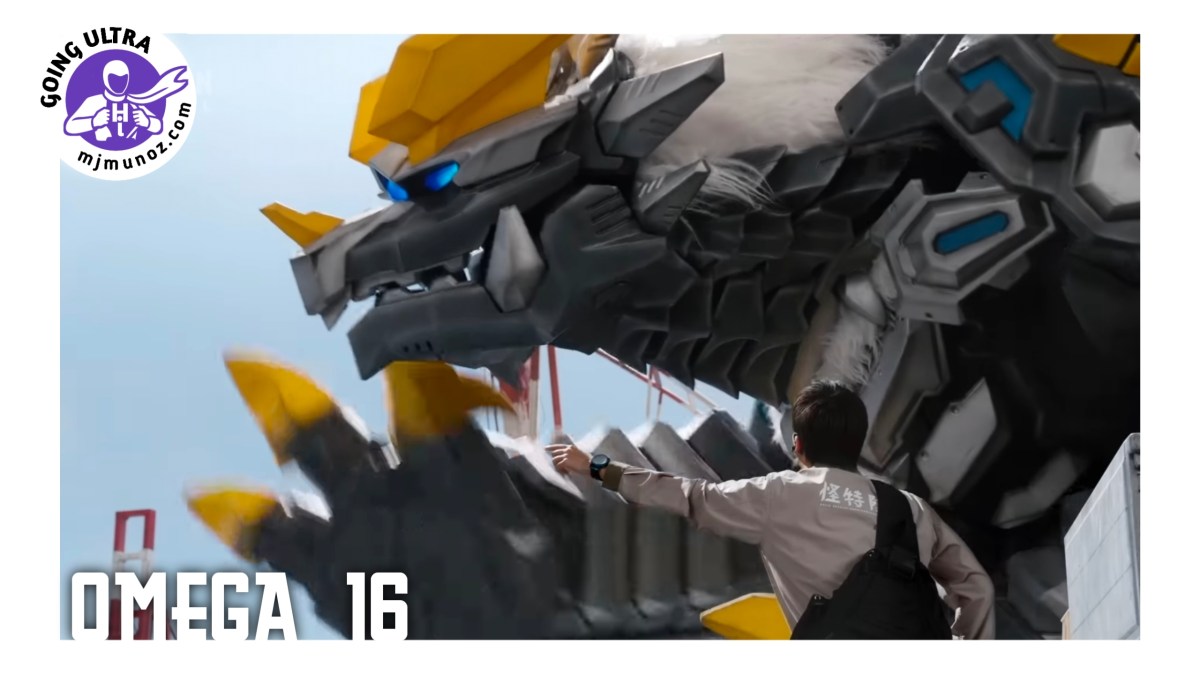
Ultraman Omega 16 – Going Ultra – Presented by Henshin Inspection
The video and audio above contain the full unfiltered analysis. What follows is the razor focused version of the strongest point I had to make.
Ultraman Omega 16 Sets the Standard
Ultraman Omega 16 Proves the Show’s Format Isn’t the Problem
Ultraman Omega 16 sets the standard for what the show could be and should be.
This isn’t the high bar for Omega. If Episode 5 is the high bar, then Episode 16 is the low bar. This is the minimum the show should ever be.
That’s not because there’s a defense team now. It’s not because Sorato, Kosei, and Ayumu are running around solving a kaiju mystery. It’s because everything is handled with consistency and a degree of seriousness, even while the episode stays lighthearted and funny.
For me, Omega 16 proves something important:
The show’s problems were never caused by being family-friendly, episodic, or toy-driven.
This episode does all of those things and still works.
Why Omega 16 Works So Well
You could make this someone’s first episode of Ultraman Omega and it would work.
The episode has a beginning, middle, and end. Sorato, Kosei, and Ayumu officially join the KSCT’s Unit Uta, investigate a strange kaiju, discover how it works, and overcome it together.
At the same time, the episode feels connected to a larger world. There’s a sense that things happened before this story and that more things will happen afterward.
That’s all you really need.
Omega 16 strikes a balance between episodic and serialized storytelling. Most of the episode stands on its own, but there’s just enough larger context to make the world feel alive.
The Comedy Comes From Character
One of the episode’s greatest strengths is its comedy.
I believe comedy should come from character, and that’s exactly what happens here.
The episode introduces Alligatortois, a slippery kaiju covered in slime. The gimmick is inherently funny, but the show keeps finding new ways to build on it. Omega can’t get a grip on the creature. Attacks slide off. Grapples fail. Even Trigaron gets caught up in the chaos.
The comedy isn’t there to mock the story.
The comedy comes naturally from the situation.
That’s why it works.
Trigaron Nearly Steals the Show
Trigaron has some of the best moments in the episode.
The visual of him sliding uncontrollably after stepping in the slime is hilarious. Later, when Alligatortois escapes into the water, Trigaron charges after it before abruptly stopping at the shoreline.
He can’t swim.
The joke shouldn’t work as well as it does, but it absolutely does.
Kosei wants him to help Omega. Trigaron essentially tells him he can’t because he’s a giant cat. Then he immediately nopes out of the situation and returns to his smaller form.
It’s funny, charming, and memorable.
More importantly, it feels sincere.
The show isn’t making fun of itself. The characters take the situation seriously, which is exactly why the joke lands.
An Unconventional Win Condition Makes the Fight Better
Another reason Omega 16 succeeds is that the solution isn’t just “hit the monster harder.”
Omega struggles against Alligatortois for most of the battle.
The kaiju is too slippery to grapple. It’s too fast to hit consistently. Conventional tactics don’t work.
The heroes have to figure out how the creature functions.
Once they learn that Alligatortois controls its size through body temperature, the battle becomes a problem-solving exercise. Omega uses the Valgeness Armor’s freezing abilities to lower its temperature, stop its movement, and force it back into its smaller form.
That’s a much more interesting win condition than simply overpowering the monster.
Not every episode needs an unconventional solution, but rotating through different kinds of challenges would make the series much stronger overall.
The Small Amount of Serialization Matters
Omega 16 is mostly episodic, but it includes just enough ongoing story to keep me interested.
The KSCT captures Alligatortois instead of destroying it.
That immediately raises questions.
What happens to captured kaiju in this world? What will the KSCT do with it? Should they be studying these creatures?
The show doesn’t answer those questions yet.
It doesn’t need to.
The possibility is enough.
Likewise, Sayuki’s comments at the end of the episode hint that there may be larger developments ahead. The episode doesn’t stop to explain everything, but it leaves breadcrumbs for future stories.
That’s effective serialization.
Ultraman Omega 16 Should Be the Baseline
Omega 16 doesn’t radically advance the overarching story.
Normally, that’s something I criticize.
This time, I don’t mind.
The episode succeeds because the fundamentals are strong. The characters are enjoyable. The comedy works. The fight has a creative solution. The world feels larger than the immediate plot.
This is what Ultraman Omega should be at a minimum.
If every episode reached this level, I’d be much higher on the series overall.
Omega 16 isn’t the best episode of the show.
But it might be the clearest example yet of what the show should have been aiming for all along.
All Zeztz Analysis | All Omega Analysis
Drop a comment below or tag me @MJ_Scribe on Twitter. Let’s have some fun talking about this.
If you enjoy thoughtful stories for kids and families, check out my book Mockwing Mayhem. Its a heartfelt adventure about magical bugs battling monsters and protecting children.
You can find more of my reviews, reflections, and stories with spine at mjmunoz.com, and join the mailing list there for behind the scenes updates and new releases.
Dive deeper with Inspector’s Notes:
Does Ultraman Think Kaiju Lives Matter?

That’s a funny way to phrase it, but I don’t entirely mean it as a joke.
One thing Ultraman has always seemed interested in is whether kaiju are monsters, animals, endangered species, or something in between. The franchise plays with that idea a lot, but from my perspective it rarely sits down and addresses it seriously.
Omega 16 got me thinking about that again.
Nuance or Inconsistency?
I’ve heard there’s a great episode of the original Ultraman called The Kaiju Graveyard. Throughout the franchise, there have also been episodes where kaiju are treated more gently. They’re not just monsters to be destroyed. They’re animals. They’re endangered species. They’re living creatures.
But then there are plenty of other episodes where the kaiju gets blown up and everybody moves on.
That’s why I keep coming back to the question of whether this is nuance or inconsistency.
Because nuance and inconsistency can look a lot alike.
Sometimes Ultraman treats kaiju like natural disasters.
Sometimes it treats them like dangerous animals.
Sometimes it treats them like victims.
Sometimes it treats them like endangered species.
And sometimes it seems to bounce between all of those ideas without really settling on one.
Why Ayumu Makes This Interesting
What really got me thinking wasn’t actually Alligatortois.
It was Ayumu.
Ayumu is exactly the kind of character who would care about kaiju lives. She’s someone who cares about animals, ecosystems, and endangered species. So when she uses the K-Monitor’s stun cartridge on Alligatortois and reacts the way she does, it stood out to me.
That reaction makes sense coming from her.
Now, that doesn’t mean she’d let a dangerous kaiju run wild through a city.
If it’s one kaiju life versus dozens, hundreds, or thousands of human lives, the answer is pretty obvious.
You stop the kaiju.
We’ve already seen her help stop dangerous kaiju before.
But there’s still a difference between stopping a threat and exterminating a creature simply because it’s inconvenient.
The Moment Alligatortois Survives
What I found most interesting about Omega 16 is that the KSCT doesn’t kill Alligatortois.
They cart it away.
The moment they do that, the whole conversation changes.
Now I’m wondering what happens next.
Are they going to study it?
Experiment on it?
Keep it imprisoned?
Try to understand it?
This is a world that supposedly has never had kaiju before. Kaiju are a new thing. Humanity doesn’t really know what these creatures are yet or how they should be treated.
That’s why the ending stuck with me.
The episode doesn’t really address any of these questions directly, but it accidentally raises them anyway.
Do Kaiju Lives Matter?
I’m not even sure Omega intended to make a statement here.
Maybe Ayumu’s reaction was just a throwaway joke.
Maybe Alligatortois never appears again.
Maybe the KSCT is just collecting data and none of this matters.
But the episode still made me think about something Ultraman has been playing with for decades.
Do kaiju lives matter?
Not more than human lives.
Not at the expense of protecting people.
But if kaiju are living creatures instead of simply monsters, then maybe the question isn’t whether they should be stopped.
Maybe the question is what responsibility humans have toward them after they’ve been stopped.
Omega 16 doesn’t answer that question.
But it made me think about it, and honestly, that’s more interesting to me than the fight itself.

