
Kamen Rider Zeztz 42 – Rider Tears
Watch Analysis
The video and audio above contain the full unfiltered analysis. What follows is the razor focused version of the strongest point(s) I had to make.
The Best Part of Zeztz 42 Isn’t the Action
Kamen Rider Zeztz Episode 42 makes Baku one of the most compelling Rider protagonists in the franchise, and it does it through a fight.
On the surface, this is a flashy battle between Baku and Catastrophe Gore Nightmare. But underneath the explosions and transformations, the episode is doing some surprisingly rich character work. Instead of stopping the action for a quiet conversation, it lets the fight itself become the conversation.
That’s something I wasn’t expecting, and it’s one of the episode’s greatest strengths.
The Fight Develops Character Instead of Interrupting It
In older Rider series—and especially in Super Sentai or Power Rangers—you often get quiet moments before or after the action where characters reflect on what they’ve learned. The battles can sometimes feel separate from the story.
Here, the battle is the story.
Baku believes Minami has been killed when Catastrophe destroys the Zeztz Room. He rushes in to save her, and once he realizes she’s alive, he transforms into Exdream and confronts Catastrophe.
At first, the fight feels strange because so much of it repeats. The same attacks happen over and over. The same exchanges loop again and again.
But as the battle continues, those repetitions develop their own grammar. The loops stop feeling repetitive and start communicating something deeper about who Baku is.
As I like to say:
Conflict reveals character.
Every Time Baku Grows Stronger, So Does Catastrophe
One of the episode’s most interesting ideas is that every time Baku reaches for more power, Catastrophe becomes stronger as well.
The mechanics are a little muddy, but we can clearly observe it happening.
At first Baku rewrites the dream to counter Catastrophe.
Then Catastrophe adapts.
He becomes faster.
He hits harder.
He starts overwhelming Baku before Baku can react.
The enemy isn’t just keeping up—it’s evolving alongside him.
Persistence Becomes Baku’s Greatest Strength
Instead of giving up, Baku simply refuses to stop.
Just like he spent what felt like decades inside the dream creating the Exdream Driver, he keeps pushing forward.
He keeps restarting.
He keeps trying again.
He keeps rolling the fight back until he can find a way through.
At one point he essentially declares:
I’ll keep doing this until the dream lets me beat you.
That’s such a wonderfully Baku moment.
He’s not winning because he’s naturally stronger.
He’s winning because he refuses to quit.
A Hopeful View of Life
Catastrophe represents pure destruction.
Its philosophy is simple:
Everything that exists should be destroyed.
And yes, everything eventually dies.
Even stars burn out.
But that doesn’t mean life has no value.
It doesn’t mean goodness doesn’t exist.
It doesn’t mean we should surrender to despair.
Baku rejects that worldview simply by continuing to fight.
Not because he’s cheerful.
Not because he’s naïve.
He’s actually a remarkably normal person.
That’s one of the things I appreciate most about him.
He isn’t an overly goofy protagonist.
He isn’t especially dark or brooding either.
He’s just…a normal guy.
That makes his perseverance feel attainable instead of mythical.
Why Baku Is Becoming One of My Favorite Rider Protagonists
Baku shows that ordinary people can face extraordinary circumstances.
Terrible things can happen to you.
Life can knock you down over and over.
But you keep getting back up.
You keep moving forward.
You keep trying.
And sometimes extraordinary things happen precisely because you refused to stop.
That’s an incredibly hopeful message.
Final Thoughts
Episode 42 impressed me because it trusted the action to carry the story.
Yes, there’s dialogue throughout the fight, but the choreography, repetition, and escalation all work together to reveal Baku’s character rather than simply entertain.
That’s difficult to pull off.
The result is one of the strongest fights in Kamen Rider Zeztz so far—not because it’s the biggest spectacle, but because it tells us exactly who Baku is.
He’s an ordinary person who refuses to surrender.
And that’s exactly what makes him an extraordinary Kamen Rider.
Do you appreciate Baku the way I do? Did this episode show his virtue to you?
Drop a comment and let me know where you stand on this.
Inspector’s Notes
Was Nasuka’s Farewell to Kureja Enough?
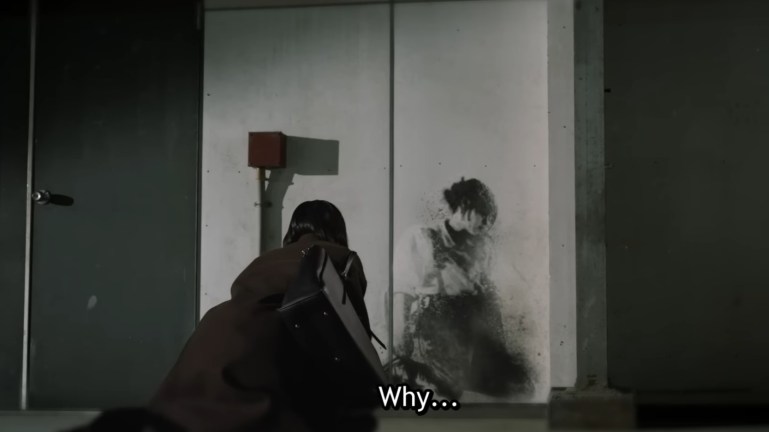
One of the quieter moments in Kamen Rider Zeztz 42 is Nasuka returning to the place where Kureja died. She sees Kureja’s silhouette on the wall and gets one last moment with her…sort of.
I think it’s interesting.
I think it’s beautiful.
I think it’s emotional and touching.
From a tokusatsu production standpoint, it’s also impressive. Assuming this isn’t CGI, I’m guessing they actually made a stencil of Kureja’s silhouette and spray-painted it onto the wall. That’s a wonderfully economical effect that still carries a surprising amount of emotion. Even if it is CGI, the scene works because Nasuka completely sells it.
The real question isn’t whether the scene works.
The question is whether it’s enough.
I’m honestly not sure.
It’s definitely better than nothing. I’m glad the series acknowledges Kureja’s death instead of simply moving on. But after everything these two characters shared, I can’t decide whether this farewell gives their relationship the emotional payoff it deserves.
Maybe it does.
Maybe it doesn’t.
Part of the question may simply come down to the kind of show Zeztz is trying to be.
This is fundamentally Baku’s story. He’s the Rider. He’s the protagonist. Everyone else exists, to one degree or another, to build his character or the world around him. That’s different from a team series like Super Sentai, where multiple characters are expected to receive substantial emotional arcs.
Does that change your expectations?
Should supporting characters in a single-Rider series receive the same level of emotional closure that we’d expect in an ensemble show? Or is a quieter, simpler farewell enough because the story ultimately belongs to Baku?
I don’t know that I have an answer.
I appreciated the scene. I thought it was heartfelt, understated, and effective.
I’m just still wondering whether it was enough.
Does Kamen Rider Zeztz 42 Have a Power Scaling Problem?
One thing that kept bothering me during Kamen Rider Zeztz 42 is the power scaling.
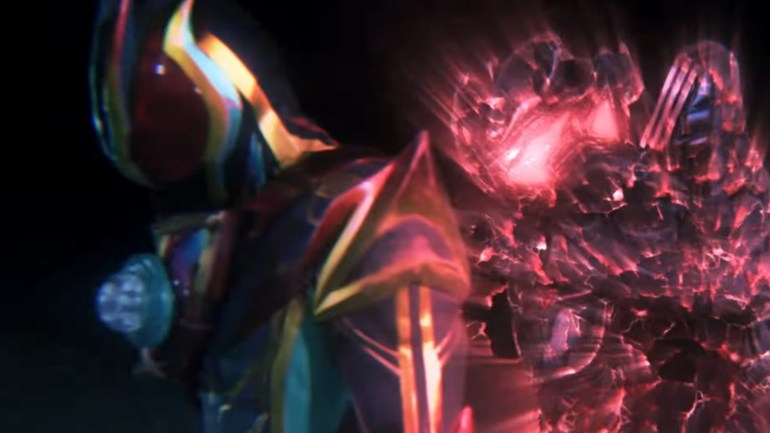
Baku confronts Catastrophe Gore Nightmare, and we’re told that every time Baku demands more power from the Exdream Driver, Catastrophe becomes stronger too.
How?
Why?
I don’t really understand the mechanics, but the episode clearly shows that it’s happening.
The question is whether that power is actually meaningful.
Ultimately, Baku wins by getting stronger himself. He keeps manipulating the Exdream, rolling the fight back over and over until he finally defeats Catastrophe.
But what actually changed?
Did Baku simply outlast him?
Did he eventually become stronger?
Was he playing the odds until one run finally worked?
Or was Catastrophe accumulating damage while Baku effectively reset himself each time?
I honestly don’t know.
The rollback mechanic is fascinating, but I’m not sure I understand how it works.
If both combatants are resetting every time, why does Baku eventually win?
If only Baku is resetting, then why does Catastrophe continue getting stronger?
If only Catastrophe retains damage, that explains the ending—but I’m not convinced that’s what the episode is showing.
That’s why this fight leaves me scratching my head.
There’s so much power being thrown around that I’m wondering whether Zeztz is starting to drift into power bloat.
Both fighters just keep becoming stronger and stronger until eventually one of them is suddenly strong enough to kill the other.
Does that feel meaningful?
Or does it start feeling arbitrary?
Maybe I’m misunderstanding the mechanics entirely. Maybe there’s a cleaner way to interpret what’s happening that makes all of this click.
If there is, I’d genuinely like to hear it.
Because this is one part of Episode 42 that I still can’t quite wrap my head around.

