

Kamen Rider Zeztz 43 – Rider Tears
Watch Analysis
The video and audio above contain the full unfiltered analysis. What follows is the razor focused version of the strongest point(s) I had to make.
Sieg’s Redemption Doesn’t Happen in Episode 43—It Begins
Kamen Rider Zeztz Episode 43 made me want to believe in redemption. It made me want to believe in humanity. It made me want to give Sieg a second chance.
I think a lot of people are going to walk away from this episode saying, “Sieg is redeemed.”
I don’t agree.
I think he has taken his first step toward redemption.
Earlier in the series, Baku said Sieg would have a chance to repent for what he had done. Episode 43 finally gives him that chance. Takahashi wasn’t saying redemption is instant. He is showing that redemption begins when someone chooses to confront who they have become.
That is a much more interesting story.
Redemption Begins by Facing Your Sins
One of my favorite details in the episode is the transformation phrase associated with Sieg’s Breakam Dawn:
“Face Your Sins.”
That isn’t just a cool henshin line anymore. It is the entire point of his character arc. The Breakam Dawn is both Sieg’s sword and the transformation device he uses to become Kamen Rider Dawn.
To me, repentance follows a simple pattern:
You regret what you have done. You feel genuine remorse for it. Then you resolve not to do it again.
But the greatest test comes afterward.
It is one thing to avoid making the same mistake. It is another to stand in the same situation, face the same choices, and choose differently. That is when you can demonstrate that you have actually changed.
If you never confront what you have done, you never really overcome it.
That is why “Face Your Sins” is such a perfect transformation call. Before Sieg can become someone new, he has to stop running from who he was.
Episode 43 Finally Made Me See Sieg as a Person
More than anything else, this episode changed how I see Sieg.
Not as a villain.
As a person.
The flashbacks showing him as a child explain so much without excusing what he has done. Watching his family hand him a gun is not simply watching a child receive a weapon. It is watching a child be taught that his purpose is to hurt people.
He wasn’t raised to become a person.
He was raised to become a tool.
That does not erase his responsibility for his choices, but it does explain how he became the man we have been watching throughout the series.
For the first time, I found myself feeling genuine affection for him instead of simply seeing him as an antagonist.
Sieg’s Suit Has Been Telling This Story All Along
One of the smartest things Episode 43 does is tie Sieg’s emotional journey directly into his visual design.
Throughout the climax, we see different versions of Sieg—his childhood self, his former CODE assassin self, and the person he is now—all sharing the same hole in their chest.
The visual effect is phenomenal.
More importantly, it means something.
That hole represents the emptiness left by the life Sieg was forced into. He was not raised to develop his own heart, identity, or purpose. He was raised to become a killer who fulfilled the needs of his crime family.
That makes the established design of Kamen Rider Dawn suddenly feel even more significant.
Sieg transforms through the Breakam Dawn, the sword into which he inserts the Punish Capsem. The object covering Dawn’s chest is not his transformation Driver. It is a separate part of the suit called the Punishmenter, a special device that forms around his chest and restrains his core.
Visually, it resembles something strapped over the place where his heart should be—almost like a covering placed across the void in his chest.
Episode 43 takes that existing piece of costume design and connects it to the hole inside Sieg. It makes the Punishmenter look less like an arbitrary mechanical detail and more like a visual expression of the person underneath the armor: restrained, wounded, and covered over rather than healed.
That is visual storytelling at its best.
The suit wasn’t merely designed to look cool. Its shapes and components now reinforce Sieg’s character arc, bringing his appearance and his story together in one coherent image.
Baku and Sieg Were Raised for the Same Purpose
Episode 43 also highlights an interesting parallel between Baku and Sieg.
Both were raised to fulfill their fathers’ ambitions.
Baku was raised to become a tool for saving people.
Sieg was raised to become a tool for hurting them.
Neither was truly allowed to become his own person.
The difference is that Baku eventually chooses compassion. Now Sieg is finally beginning to make his own choices instead of simply carrying out someone else’s purpose.
That parallel makes their relationship far more interesting than a simple hero-versus-villain conflict.
Nem Challenges Sieg to Face the Truth
The episode also reinforces this idea through Nem.
Throughout the series, I have wondered whether Sieg and Nem function as foils for one another. Sieg is obsessed with nightmares and with making bad dreams come true. Nem was born from a Nightmare, yet she wants to help people make their dreams come true.
Here, that connection becomes even stronger.
Sieg sees something troubling in Nem. Whether he is projecting his own darkness onto her, recognizing a natural consequence of her origins, or perceiving something she has not admitted to herself, he appears to identify an uncomfortable truth.
Nem does not simply run from it. She says she will face it.
Watching her choose to confront that possibility inspires Sieg to face his own sins, his own Nightmare, and Punish himself.
Truth comes before change.
The episode keeps returning to that idea.
Punish Understands Guilt—but Not Redemption
Punish argues that humanity deserves punishment because all people are full of sin.
Baku answers with one simple truth:
That isn’t your decision.
That moment ties the entire episode together.
Punish understands guilt.
He understands condemnation.
But he does not understand redemption.
Episode 43 argues that people are more than the worst things they have ever done. They still have to face those things. They still have to take responsibility for them. But they also retain the possibility of becoming someone different.
That is exactly what Sieg begins to do here.
Final Thoughts
Episode 43 does not ask us to forgive Sieg.
It asks us to believe that people can change.
That is a very different thing.
By confronting his past instead of running from it, Sieg finally takes the first genuine step toward redemption. The episode never pretends that one choice is enough. Instead, it presents repentance as the beginning of a journey rather than its destination.
And somehow, in the middle of a show filled with impossible monsters, dragons, and over-the-top Rider battles, Yuya Takahashi tells a story that feels deeply human.
I honestly did not expect Sieg to be the character who made me think about redemption this much.
But here we are.
It worked.
Do you think Sieg us redeemed? Is he just starting? Is he ju
Drop a comment and let me know where you stand on this.
Inspector’s Notes
What If Sieg Is Right About Nem?

One of my favorite moments in anything happens in this episode.
Nem grabs Sieg’s sword and lets it cut her hand just so they’ll stop fighting long enough to have an honest conversation.
I don’t know if it’s a trope or not, but it’s one of my favorite things I’ve seen in Japanese media. There’s something powerful about someone willingly accepting pain to prove they’re serious. It immediately changes the tone of the scene. This isn’t just another argument. This matters.
But that’s not actually what stuck with me after the episode.
What stuck with me is the question Sieg asks Nem.
What if he’s right?
Sieg insists that the nightmares are coming from Nem. He tells her that whatever horrors he’s created are nothing compared to what she carries inside herself. Up until now, I dismissed that as another manipulation from a villain trying to hurt someone emotionally.
Now I’m not so sure.
The episode makes me wonder if Sieg has actually recognized an uncomfortable truth.
The interesting question isn’t whether the nightmares originate with Nem.
The interesting question is whether that makes her responsible for them.
Those are two very different things.
If the nightmares really are connected to Nem, they seem to be happening unconsciously. She isn’t choosing to create them. She isn’t waking up every morning thinking about how to spread suffering. If anything, she’s been consistently trying to do the opposite.
So is she actually culpable?
I don’t think she is.
At least, not based on what we’ve seen so far.
There may be something else going on entirely. Maybe her very existence makes nightmares possible. Maybe being born from Nightmare naturally affects the world around her in ways she can’t control. Whatever the explanation turns out to be, that feels fundamentally different from choosing to hurt people.
And I think that’s what makes Nem such an interesting character.
She’s carrying a burden she may never have chosen.
A curse.
A fate.
Something woven into who she is.
Yet none of that has stopped her from choosing to do good.
That’s the part that matters.
No matter where she came from or what powers she possesses, she still has agency. She still chooses kindness. She still fights against whatever destiny seems to be waiting for her.
In fact, that’s exactly what inspires Sieg in this episode.
Watching Nem decide to face whatever truth awaits her becomes one of the catalysts for Sieg finally facing his own sins. He sees someone refusing to run from an uncomfortable reality, and for perhaps the first time in his life, he decides to do the same.
That’s beautiful.
It’s also why I find Sieg’s role in this conversation so fascinating.
He’s done terrible things.
He’s spent most of the series trying to hurt people.
Yet here he may be speaking a truth that nobody else has been willing—or able—to say.
Villains don’t have to be wrong about everything.
Sometimes they’re the ones willing to point at the truth everyone else is avoiding.
The real question is what we do with that truth once it’s comes into the open.
For Nem, the answer isn’t despair.
It isn’t surrendering to fate.
It’s continuing to choose who she wants to become.
And if that’s where this story is heading, then I think that’s a far more interesting direction than simply revealing whether Sieg’s accusation was technically right or wrong.
Because even if he is right, Nem’s origin doesn’t have to define her.
Her choices do.
Sieg’s Suit Was Telling His Story All Along
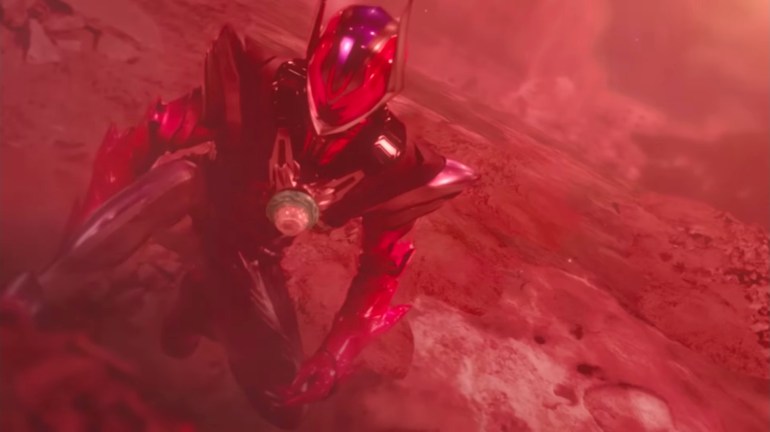
Is Kamen Rider Dawn’s suit perfect?
It might be.
One of my favorite things in storytelling is when a character’s design isn’t just cool—it actually communicates something about who they are. Episode 43 made me realize that’s exactly what has been happening with Sieg ever since he first appeared.
Looking back, the clues were always there.
The most obvious one is the large X-shaped restraint across the center of his chest. It always looked important. It naturally drew my eye, almost as though it was waiting for something to happen there. Yet throughout the series, Sieg transforms through the Breakam Dawn, using the sword that has become an extension of who he is. The chest piece remains in plain sight, but its significance isn’t obvious.
Until now.
Episode 43 reveals that Sieg has been living with a hole in his heart—not just emotionally, but visually. Throughout the climax, we see the wound carried across every stage of his life: the frightened child, the CODE assassin, and the man he is trying to become.
Suddenly, that chest restraint means something.
It feels less like a random mechanical detail and more like something sealing over the emptiness inside him, allowing him to keep going despite the wound he carries.
Sieg has never been whole.
He was raised to become a weapon.
A killer.
A tool for someone else’s ambitions.
He was never taught how to become a person.
Even the rest of his design reinforces that idea.
His hands are stained red.
His eyes burn crimson.
His purple armor darkens into blood-red at the extremities, making it look as though violence has seeped into every action he takes. Add the horns, the monstrous silhouette, and the transformation call—“Face Your Sins”—and the suit stops looking like a collection of cool design choices.
It becomes a visual biography.
Everything about it tells the story of someone shaped by violence, burdened by guilt, and trapped by the life he was forced to live.
Then Episode 43 changes everything.
When Sieg receives Baku’s Exdream Capsem and places it into the chest-mounted restraint, the symbolism becomes impossible for me to ignore.
For just a moment, it’s almost as though he’s been given a heart.
Not his own.
A borrowed one.
But it’s enough.
It’s enough for him to stand.
It’s enough for him to face Punish.
It’s enough for him to stop using his strength only to destroy and instead use it to protect someone else.
Only then does he begin claiming his own heart.
That might sound a little like Kingdom Hearts, but I genuinely think that’s what the episode is communicating.
The story and the costume are saying the same thing.
The dialogue.
The transformation phrase.
The visual symbolism.
The hole in his chest.
The borrowed Exdream Capsem.
They’re all pointing toward the same idea.
Sieg isn’t simply becoming more powerful.
He’s becoming more complete.
That’s why I think Dawn’s suit is so remarkable.
It isn’t just one of the coolest Rider suits in Zeztz.
It’s one of the clearest examples of costume design reinforcing character that I’ve seen in a long time.
The story was written into the suit from the very beginning.
Episode 43 simply gave us the final piece we needed to read it.

