
Omegahorn 01 – Rider Tears
The audio and video above contain the full unfiltered analysis. What follows is the razor focused version of the strongest point I had to make.
Fresh, Fun Fantasy at Last
That’s the best way I can describe Omegahorn Episode 1.
Project R.E.D. promised a new generation of heroes and worlds, and this is the first series that really feels like it’s delivering on that promise. It surprised me. It was fun. More importantly, it made me want to keep exploring.
That’s the highest compliment I can give a first episode.
Fresh, Fun Fantasy
I love the fact that they basically made a Pokémon-style tokusatsu show. It’s like a monster-tamer series, but it still feels distinctly like tokusatsu.
The music immediately drew those comparisons for me. So did Shout’s outfit and the way he turns his cap backward before battle. All of that reminded me of Ash or Red without feeling like a copy.
The episode also doesn’t settle for one aesthetic.
There’s an Old West-style town. There’s a much more technological city. The Beast Hunters have names that almost sound like something out of a wuxia film like Crouching Tiger, Hidden Dragon. Then there are giant ancient beasts and mysterious ruins.
Normally, that sounds like it shouldn’t work.
Here, it does.
Instead of feeling random, it makes the world feel larger than we’ve seen so far.
A World Worth Exploring
What really impressed me wasn’t the action.
It was the exploration.
Shout the Fire isn’t introduced as a Beast Hunter.
He’s a treasure hunter.
That immediately changes the focus of the story.
Instead of rushing from battle to battle, the episode lets him wander through ruins, climb cliffs, cross dunes, search for artifacts, and quietly investigate the world around him.
Those quieter moments ended up being some of my favorite parts of the episode.
He discovers ancient relics.
He sells them.
He doesn’t get much money.
But there’s this quiet, hopeful expression on his face that made me stop and wonder what he’s really searching for.
That curiosity carried me through the entire episode.
The Mystery Makes the Fantasy Stronger
The more the episode revealed, the more questions I had.
Who were the Ancients?
What exactly are the Kakuzyu?
Why were they sealed away?
How does the Omegahorn fit into all of this?
Why do the Egorgears transfer to the winner after a battle?
Instead of frustrating me, those unanswered questions became the episode’s biggest strength.
Every mystery made me want to learn one more thing about this world.
That’s what fantasy should do.
Fantasy isn’t just dragons, monsters, or magic.
It’s the feeling that there’s another story waiting just beyond the next hill.
Omegahorn captures that feeling remarkably well.
Shout the Fire Is an Explorer First
I also like that Shout doesn’t define himself as a Beast Hunter.
He keeps insisting that he’s a treasure hunter.
That’s important.
He built—or at least designed—the suit he wears with the help of Anna, the AI companion who operates it. Rather than making him feel like another chosen hero, the episode presents him as someone actively chasing something.
We don’t know exactly what that is yet.
We just know he has a goal.
That makes him immediately interesting.
I found myself wanting to know more about him instead of simply waiting for the next fight.
Enkaku Steals the Show
Enkaku immediately became my favorite part of the episode.
The puppeteering is excellent.
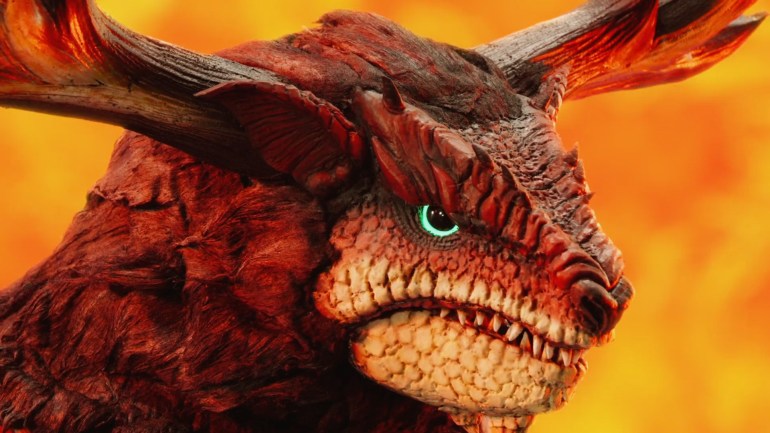
There’s one close-up of him surrounded by flames that feels grand, mystical, and ancient all at the same time.
It’s a fantastic visual.
I also love that Enkaku can assume a human form to travel alongside Shout.
More importantly, Enkaku doesn’t simply choose Shout because he’s strong.
He chooses him because something about Shout’s determination moves him.
He even talks about engraving Shout’s name onto his heart.
What exactly does that mean?
I don’t know.
And that’s another mystery I’m excited to learn more about.
This Feels Like the Project R.E.D. I Was Hoping For
By the end of Episode 1, I realized something.
This is what I wanted Project R.E.D. to be.
Fresh. Fun. Fantasy.
Gavan Infinity never really held my attention. If a show doesn’t make me want to keep watching, it’s certainly not going to make me want to invest in its world.
Omegahorn is different.
It makes me want to keep exploring.
I want to know more about Shout.
I want to understand the Kakuzyu.
I want to learn how the Beast Hunters, Egorgears, and ancient civilizations all connect.
Most of all, I simply want to go on this journey with these characters.
That’s the best compliment I can give Episode 1.
Project R.E.D. finally has a series that feels like a genuine beginning instead of just another replacement.
If Omegahorn can hold onto that sense of mystery and wonder, I’ll happily keep following wherever this adventure leads.
All Zeztz Analysis | All Omega Analysis
Drop a comment below or tag me @MJ_Scribe on Twitter. Let’s have some fun talking about this.
If you enjoy thoughtful stories for kids and families, check out my book Mockwing Mayhem. Its a heartfelt adventure about magical bugs battling monsters and protecting children.
You can find more of my reviews, reflections, and stories with spine at mjmunoz.com, and join the mailing list there for behind the scenes updates and new releases.
Inspector’s Notes
Omegahorn Doesn’t Need More Heroes

One thing I noticed while watching Omegahorn Episode 1 is that I think the people working on Project R.E.D. have taken a lesson from anime.
I don’t know whether this is intentional or not, but it feels that way to me.
When Project R.E.D. started, Gavan Infinity didn’t really hold my interest. I watched the first episode, thought it was a promising start, and then never kept going. Omegahorn, though? Omegahorn has my interest. I’m sticking around.
I started asking myself why.
Then I looked at this purple Beast Hunter.
She doesn’t really transform.
She has the Omegahorn.
She has an Egorgear.
She has this big sword.
Then, when she uses her beast’s power, she gets this little mask.
That’s it.
But somehow that little mask makes her feel like more of a character.
She’s instantly recognizable.
Then I started looking around at everybody else.
The guy she’s fighting has his huge spiked mace.
The villains all have very distinctive looks.
They’re almost like Team Rocket. Everybody has their own style and personality.
They’re themed.
That’s what stood out to me.
Nobody needs a giant transformation sequence to become memorable.
They just need a strong design.
I could easily imagine PVC figures of this Beast Hunter.
Posters.
Character merchandise.
The same goes for the villains.
They’re interesting enough that I could see people collecting them simply because they like the characters.
That made me wonder if that’s actually the strategy.
Maybe Project R.E.D. doesn’t need to sell us on a new transforming hero every few months.
Maybe it just needs to create characters people want to spend time with.
If that’s what they’re doing, I think they’re onto something.
It’s funny.
This wasn’t even something I was thinking about while I was watching the episode.
It was only afterward that I realized I could remember almost everybody’s design.
That doesn’t happen by accident.
I think that’s one of the smartest things Omegahorn Episode 1 does, and I’m curious to see whether the rest of the series keeps building on it.
Did Project R.E.D. Replace Mecha with Monsters?
One thing I kept thinking about after Omegahorn Episode 1 wasn’t the transformation.
It was the monsters.
Think about how the episode opens.
There’s this ancient war between all of the Omegahorns. Giant living creatures crashing into one another while this music that almost reminds me of Pokémon plays underneath it.
The whole time I kept thinking…
Where are the robots?
There isn’t a combining mecha.
There isn’t a Megazord.
There isn’t even a transformation sequence carrying the scene.
Instead, the stars are the creatures themselves.
That got me wondering if Project R.E.D. is trying something different.
For years, tokusatsu toy lines have revolved around machines.
You collect the vehicles.
You combine the robots.
Then next year you do it again.
Omegahorn feels different.
Instead of asking me to fall in love with a machine, it’s asking me to fall in love with Enkaku.
Or the twins’ creature that splits into two before joining back together.
Or whatever the next Omegahorn turns out to be.
That feels much closer to Pokémon than Super Sentai.
And Pokémon has already proven that people don’t just buy creatures because they battle.
They buy them because they like the creatures themselves.
People collect Pikachu.
Snorlax.
Gengar.
They put plushes in their cars.
They collect statues.
They buy shirts.
The creature becomes the merchandise.
I’m starting to wonder if that’s the real experiment behind Project R.E.D.
Maybe the question isn’t whether monster partners are cooler than combining robots.
Maybe the question is whether people are more emotionally attached to living creatures than they are to machines.
If that’s what Omegahorn is testing, then the sales figures over the next year are going to be fascinating to watch.
I think that’s a really interesting direction, and it’s one I’m looking forward to seeing play out.
Omegahorn Is Blending More Influences Than You Might Realize

One thing I kept noticing during Omegahorn Episode 1 is that the Beast Hunters already felt familiar.
Not because they reminded me of another tokusatsu series.
Because they reminded me of wuxia.
Think Crouching Tiger, Hidden Dragon.
Or The Legend of the Condor Heroes.
Or even Rurouni Kenshin.
Those stories are filled with wandering martial artists who have titles, reputations, signature techniques, and legendary accomplishments. Before they ever meet each other, people already know their names.
That’s exactly what Omegahorn is doing.
The horned Beast Hunter with the mace introduces himself.
The purple Beast Hunter introduces herself.
Later the twins do the same thing.
The battle doesn’t simply begin.
It starts with an introduction.
Almost a declaration.
That immediately reminded me of martial artists announcing themselves before a duel.
At the same time, the structure also feels a lot like Pokémon.
There are ordinary people living ordinary lives.
Then there’s this separate society of Beast Hunters who travel around, recognize one another, battle each other, and live by their own customs.
That’s a surprisingly elegant combination.
Pokémon provides the idea of a parallel culture built around creatures.
Wuxia provides the ritual, the reputation, and the drama.
Omegahorn blends those two ideas together, then gives everyone an Omegahorn and an Egorgear.
That’s a combination I wasn’t expecting, but it works.
The more I think about it, the more I realize Episode 1 isn’t borrowing from one genre.
It’s compressing decades of storytelling traditions into a battle system that immediately feels familiar, even if you can’t quite explain why.
I think that’s one of the cleverest pieces of worldbuilding in the premiere.
Loose Threads
Omegahorn’s World Is Wonderfully Eclectic
One thing I kept noticing while watching Omegahorn Episode 1 was how many different visual styles it mixes together.
Normally, you’d expect a fantasy series to establish one consistent look and stick with it.
Omegahorn doesn’t do that.
Instead, it throws all kinds of different ideas into the same world, and somehow it works.
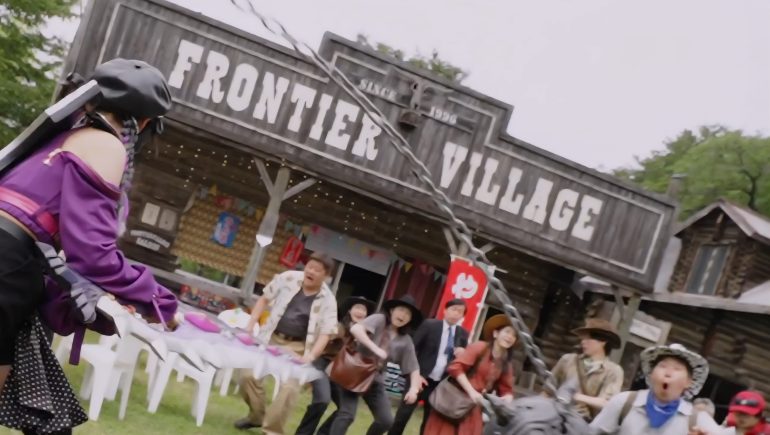
Take Frontier Village.
There’s this Old West-style town with log buildings and a sign that says “Frontier Village” and “Since 1926.” Hanging underneath are decorative lights and little festival flags. There are plastic café tables and chairs sitting outside.
Then you start looking at the people.
One guy is wearing a Trilby and an open Hawaiian shirt.
Another is wearing a business suit.
Some people have cowboy hats.
Others just look like ordinary tourists spending the day there.
Then right in the middle of all of that walks the purple Beast Hunter.
She’s dressed in this punk-goth style with braided hair, thigh-highs, oversized boots, and a giant fantasy weapon.
The man she’s fighting looks almost like a Viking, complete with a horned helmet and heavy armor.
None of those things really belong together.
Yet somehow they do.
Later, the episode shifts to the city.
Now the atmosphere changes completely.
The buildings become much more futuristic, and the villains all have their own unique looks.
There’s leather.
Metal.
One character has this elaborate white-and-gold outfit that almost feels Victorian.
Even their Omegahorns look different from the ones the Beast Hunters carry.
I heard someone suggest that maybe this is just the result of the production spending so much of its budget on the Omegahorn beasts that everything else had to be cobbled together.
Maybe.
But I actually think there’s something more interesting happening.
One of the charms of tokusatsu has always been doing a lot with a little.
Instead of hiding those contrasts, Omegahorn leans into them.
The ordinary people look ordinary.
The extraordinary people look extraordinary.
That contrast immediately tells you who belongs to the everyday world and who belongs to something larger.
The more I thought about it, the more it reminded me of an RPG.
You don’t travel from one identical town to another.
You go from a desert city…
…to a jungle village…
…to an underwater kingdom…
…to a frontier town…
Every location has its own personality.
Every place feels different.
That variety isn’t realistic.
It’s imaginative.
I think that’s exactly what Omegahorn is doing.
Rather than trying to recreate the real world, it’s building a fantasy world where every new location feels like another place you want to explore.
I honestly think that’s a strength.
The eclectic costumes…
The eclectic locations…
The eclectic production design…
They’re all helping sell the fantasy.
And for me, that’s one of the most enjoyable parts of Omegahorn Episode 1.

